
Master Allied Health Clinic Cash Flow in Australia

A full appointment book can still leave an allied health clinic short of cash when wages and operating costs are due. Allied health clinic cash flow management Australia-wide depends on recognising that billings, receipts and commitments follow different timelines. Medicare, NDIS, WorkCover and private payments each have their own billing and payment workflows, so a busy week doesn’t always mean cash is available when you need it.
Income recorded in a report and money in the bank are not the same thing. A clear routine helps you see what’s expected, what’s committed and where a delay could affect your next decision. It also connects cash visibility with the operating choices that shape it, including team capacity, patient retention and service mix.
This article will help you build a practical forecast and a steady review rhythm. You’ll learn how to track likely receipts and outgoings, spot operational causes of pressure early, and make staffing and spending decisions with greater clarity.
Key Takeaways
- Understand how allied health clinic cash flow management Australia connects expected receipts with payment dates and operating commitments.
- Separate cash flow, profit and budget so each gives you a clearer basis for clinic decisions.
- Build a repeatable forecast around your clinic’s own payment history, including private fees, Medicare, NDIS and WorkCover receipts.
- Use clean financial records alongside operational insight to identify where staffing, retention or service mix could be affecting cash.
What does allied health clinic cash flow management in Australia need to account for?
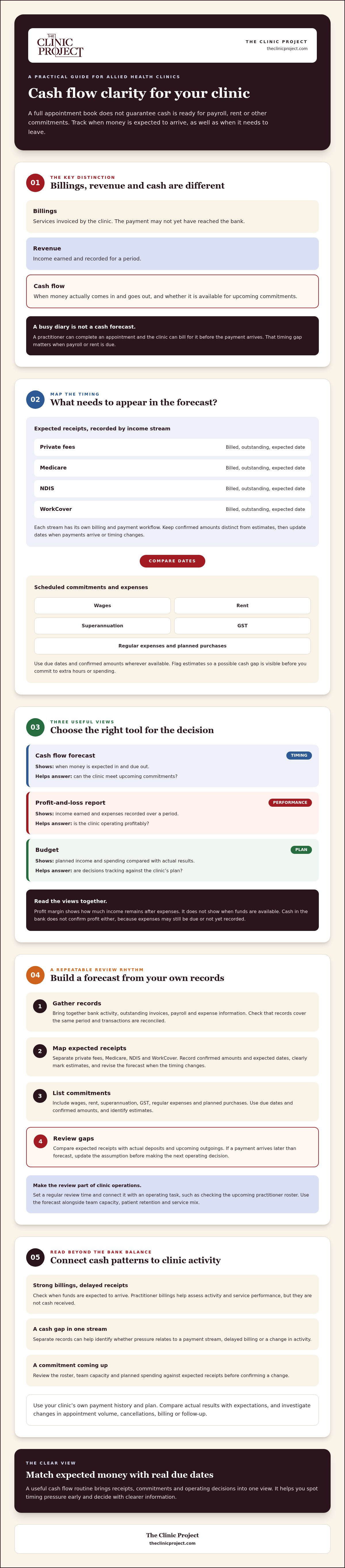
Cash flow is the movement of money into and out of your clinic over time. Billings record services invoiced, revenue records income earned and profit shows what remains after expenses. Cash flow tells you when money is actually available to meet commitments. The practical focus of allied health clinic cash flow management Australia is matching incoming and outgoing dates, using a clear view of cash flow as money moving through the business.
Cash received is different from revenue recorded
A practitioner can complete an appointment and the clinic can bill for it before the payment reaches the bank. Your profit-and-loss report helps you understand income and expenses for a period, but it doesn’t show the timing of every receipt. A full diary therefore doesn’t confirm that cash will be available for Friday’s payroll or rent due next week.
Map expected receipts against practitioner pay, rent, superannuation, GST and other scheduled commitments. Record due dates and distinguish confirmed amounts from estimates. This timing view can reveal a potential shortfall early, giving you time to review spending, staffing or payment follow-up before making a commitment.
Which allied health income streams need separate visibility?
Keep private fees, Medicare, NDIS and WorkCover receipts distinguishable in your clinic records. Each has its own billing and payment workflow, so record what’s been billed, what remains outstanding and the expected receipt date for each stream. For clinics in Australia, New Zealand, Canada, Hong Kong and Singapore, check payment processes and tax obligations against the guidance that applies in your location. Don’t assume a timeframe used in one market applies in another.
Separate records make it easier to see whether a cash gap comes from a particular payment stream, delayed billing or a change in activity. Use that information to connect financial visibility to operating decisions. You won’t be here without strategy.
How do cash flow, clinic profit and practitioner billings fit together?
Cash flow, profit-and-loss and budget answer different questions. In allied health clinic cash flow management Australia, each view helps you make a distinct decision instead of treating billings as money already available.
| Tool | What it shows | Decision it supports |
|---|---|---|
| Cash flow forecast | When money is expected in and due out | Can the clinic meet upcoming commitments? |
| Profit-and-loss report | Income earned and expenses recorded over a period | Is the clinic operating profitably? |
| Budget | Planned income and spending compared with actual results | Are decisions tracking against the clinic’s plan? |
What does a practitioner billing benchmark tell you?
Practitioner billings can help you assess activity and service performance, but they are not a universal target or a measure of cash received. Read them alongside practitioner capacity, collections and the costs of delivering care. If billings are strong but receipts are delayed, the forecast still needs to reflect when funds are expected to arrive. Compare actual results with your clinic’s own plan and investigate changes in appointment volume, cancellations, billing or follow-up.
How should owners read margin evidence?
Profit margin helps you assess how much income remains after expenses. It is not the same as cash available in the bank: payment timing and upcoming commitments determine when funds can be used. Review margin alongside the cash forecast, rather than using one figure as a substitute for the other.
For example, if income is earned but a payment has not yet arrived, the profit-and-loss report may show performance while the bank balance still needs to cover near-term costs. Conversely, cash in the bank does not necessarily mean the clinic has earned a profit, because some expenses may still be due or not yet recorded. Track Profit, People, Possibilities when reviewing the broader health of the clinic. You won’t be here without strategy.
How can allied health clinic cash flow management in Australia become a repeatable routine?
A repeatable forecast uses your clinic’s own receipt history and confirmed commitments, then changes when actual timing differs. Set a regular review time and connect it to another operating task, such as checking the upcoming practitioner roster. That way, a potential cash gap can inform a decision before you commit to extra hours or spending.
Use this five-step routine:
- 1. Gather records: bring together bank activity, outstanding invoices and current payroll and expense information. Check that records cover the same period and that transactions are reconciled.
- 2. Map expected receipts: separate private fees, Medicare, NDIS and WorkCover, recording confirmed amounts and expected dates. Mark estimates clearly and update them when a payment arrives or a date changes.
- 3. List commitments: include wages, rent, superannuation, GST, regular expenses and planned purchases. Use due dates and confirmed amounts wherever available, and note any commitment that is still an estimate.
- 4. Review gaps: compare expected receipts with actual deposits and upcoming outgoings. If a payment arrives later than forecast, update the assumption and check whether billing, attendance or follow-up processes changed.
- 5. Decide the action: record what needs attention, who owns it and when you’ll check the result. This keeps the forecast connected to a practical next step rather than leaving it as a spreadsheet that no one acts on.
What should the review change?
A forecast earns its place when it shapes a decision. Before adding a practitioner, extending a roster or increasing marketing activity, check whether clinic capacity and expected cash support the commitment. Review retention and rebooking patterns too. Gaps in follow-up can affect the future appointment pipeline, so identify a process change and monitor what happens rather than assuming it will produce a particular financial result.
Use clinic data as an operating tool by connecting the forecast to the roster, patient follow-up and the owner’s next decision. That’s the practical purpose of allied health clinic cash flow management Australia: giving you a repeatable view of timing so choices are grounded in your clinic’s actual conditions. The Clinic Project’s Impact Call with Winnie is an opportunity to discuss the operational bottleneck affecting your clinic.
Which support helps turn cash flow visibility into better clinic decisions?
Different support answers different questions. A bookkeeper can help organise transactions, invoices and reconciliations, giving you a clearer view of receipts and outstanding payments. An accountant can advise on tax and reporting matters, while strategic business guidance connects the figures to choices about practitioner capacity, retention, team structure and your role in the clinic.
If records are incomplete, receipt status is unclear or reconciliation questions remain unresolved, prioritise financial administration. Discuss tax and reporting matters with a qualified accounting professional in your location, and refer to the ATO’s business information for relevant Australian guidance. Clinics in New Zealand, Canada, Hong Kong and Singapore should use the relevant local guidance for their tax and reporting obligations. Clean records create a reliable starting point. You still need to decide how the clinic will respond to what they show.
When cash concerns connect to a full roster, inconsistent rebooking or decisions waiting for your approval, the next question is operational. The Clinic Project provides tailored business coaching and strategic consulting for allied health clinic owners. Its Set to Scale program focuses on clarifying business metrics, building robust systems and streamlining day-to-day operations, so owners can address the operational choices behind the figures. A clear understanding of cash flow is one part of that picture.
The Clinic Scale Pathway helps owners understand their clinic’s revenue and operational stage, while the Freedom Pathway aligns the Scale Sequence with the three pillars of Profit, People, Possibilities. Use the framework to consider whether your next priority is financial visibility, team systems or the opportunities you want the clinic to support.
Build cash visibility into your clinic’s operating rhythm
A steady review helps you see expected receipts alongside wages, rent, superannuation, GST and other commitments. It also gives you a clearer basis for decisions about practitioner capacity, patient retention and planned spending.
That’s the practical purpose of allied health clinic cash flow management Australia: connecting payment timing with the operating choices that shape your clinic. A forecast shows when funds are expected; your profit-and-loss report helps assess performance. Use both to guide decisions with a clear view of current commitments.
Profit gives you more information for making choices, while effective systems help you manage day-to-day operations. Review your clinic’s own figures rather than relying on a general margin or billing benchmark. Compare planned and actual results, understand what changed, and connect any action to the clinic’s priorities. This is a measured process, not a guarantee of a particular financial outcome.
If you’d like to discuss the bottleneck affecting your clinic’s cash and operating decisions, Book an Impact Call with Winnie. A clearer routine can help you make your next decision with greater confidence.
Frequently Asked Questions
What is cash flow management for an allied health clinic?
Cash flow management is the process of tracking when money is expected to enter and leave your clinic, then using that timing to guide decisions. A useful routine records receipts from private fees, Medicare, NDIS and WorkCover separately, alongside commitments such as practitioner pay, rent and superannuation. For allied health clinic cash flow management Australia-wide, use your own payment history and confirm current payment details.
Why can a busy allied health clinic still have cash flow problems?
A full appointment book doesn’t guarantee that payments have reached your bank account by the time expenses are due. Billings, receipts and outgoings can follow different timelines, while cancellations, incomplete billing or delayed follow-up can affect expected receipts. Compare forecast amounts with actual deposits, then check the relevant billing or attendance process before making new commitments.
How often should an allied health clinic review cash flow?
Review your expected cash position weekly and compare actual receipts with the forecast at least monthly. A weekly check can flag a timing gap before payroll, rent or a planned purchase is due; the monthly review helps you update assumptions based on what actually happened. Assign someone to maintain the figures and bring exceptions, such as an overdue invoice, to the owner’s attention.
Is cash flow the same as profit in a private practice?
No. Profit measures income earned against expenses recorded over a period, while cash flow tracks when money is received and paid. A clinic can report a profit while waiting on billed appointments to be paid, or hold cash before all expenses are recorded. Use the profit-and-loss report to assess performance and the cash forecast to plan for payment timing and commitments.

Article by
Winnie Wu
Physiotherapist Winnie Wu builds allied health clinics that are highly profitable and run without their owner. She has founded four health brands. Her two Sydney clinics, Movement Laboratory and the award-winning Papaya Clinic, let her take three to four months off every year. Through The Clinic Project she works directly with women clinic owners on profit, systems and leadership, and her Set to Scale clients average a 32% profit margin, more than double the industry average. Every framework she teaches runs in her own clinics first.