
Clinic Director Leadership Coaching: Leading a Large Team

Clinic director leadership coaching helps allied health clinic owners clarify who makes decisions, so routine work does not keep waiting for the director. When the books are full but roster changes and patient handovers still need your approval, the team’s growth can leave you with less room to lead.
Clear decision rights and practical systems give staff confidence to act within agreed boundaries. They also give you more time for the leadership work that will move the clinic forward.
Key Takeaways
- Leadership development for a clinic director should strengthen decision-making, delegation and team leadership in daily operations.
- Map recurring decisions, assign an owner to each and set escalation rules so staff know when to act and when to involve you.
- Individual leadership guidance, peer mentoring and operational strategy address different needs. Start by naming the decision or challenge you need to resolve.
- Begin with one recurring bottleneck and one system to improve. I have grown two clinic brands while taking three to four months off each year since 2022, which has reinforced the value of designing operations to work beyond the director’s daily presence.
Clinic director leadership coaching: what should it change in your clinic?
Effective leadership development clarifies how decisions are made and who owns them, so routine operational questions do not keep returning to you.
You might still be approving roster swaps, answering questions about patient handovers or resolving small scheduling issues, even with full books and a strong reputation. When those decisions wait, care coordination slows and strategic work gets pushed aside. The aim is to build leadership systems that suit your clinic’s structure and support confident action across the team.
The Messy Middle: the growth stage where systems and leadership strain
The Messy Middle: the growth stage where clinics expand but systems and leadership strain under added complexity. Your team may be busy and your clinic well known, while decision rights remain informal. A message asking you to approve a routine roster change after hours is a sign that an everyday decision still depends on you.
What leadership support should address in an allied health clinic
Director decisions shape how practitioners understand their responsibilities, how reception communicates appointment changes and how consistently patients experience care across clinicians. Leadership work should reflect your actual structure: who manages the roster, who handles patient concerns and which decisions belong with the clinical lead or practice manager.
As a physiotherapist, founder and systems architect, I look at how leadership decisions function inside an operating clinic. Allied health leadership systems also need to support practitioners in meeting their professional responsibilities. AHPRA and the National Boards’ shared Code of conduct provides a professional reference point. In clinic operations, a practical example is defining who responds when a patient raises a concern and when the matter needs clinical review.
How does clinic director leadership coaching build a team that can decide?
Clinic director leadership coaching can make decision rights visible in everyday systems. Staff need to know who can decide, what they can decide and when to escalate. That clarity supports reliable operations and reduces the number of routine questions that need the director’s attention.
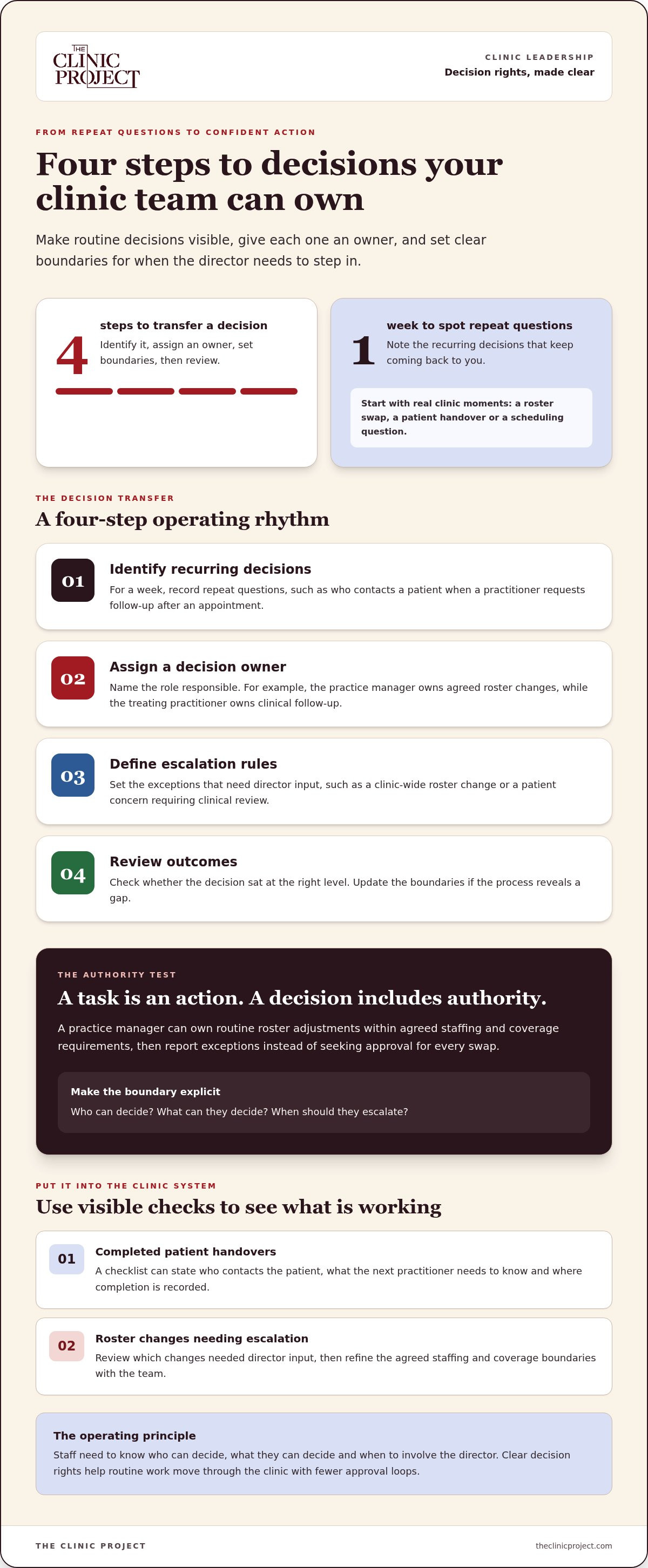
Use this four-step process to transfer a recurring decision into the team’s hands:
- Identify recurring decisions. For a week, note repeat questions, such as who contacts a patient when a practitioner requests follow-up after an appointment.
- Assign a decision owner. Name the role responsible, such as the practice manager for agreed roster changes or the treating practitioner for clinical follow-up.
- Define escalation rules. Set out the exceptions that need director input, such as a change affecting the clinic-wide roster or a patient concern requiring clinical review.
- Review outcomes. Check whether decisions were made at the right level. Update the boundaries when the process exposes a gap.
Delegate decisions with clear boundaries
A task is an action; a decision includes authority to choose what happens next. A practice manager can own routine roster adjustments within agreed staffing and coverage requirements, then report exceptions rather than seeking approval for every swap. The link to leadership and executive coaching services in government is an example of formal leadership development focused on leadership capacity and personal effectiveness.
Make leadership visible in clinic systems
Choose indicators that show whether the system is working, such as completed patient handovers or roster changes that needed escalation. A handover checklist can specify who contacts the patient, what information the next practitioner needs and where completion is recorded. Review the process with the team so staff can flag unclear responsibilities and you can see where the system needs refinement.
For established clinic leaders building decision-making across a larger team, the Impact Mastermind offers a peer and strategic setting to work through leadership priorities.
How do leadership coaching, peer mentoring and operational strategy differ?
Choose support according to the decision you need to make. Individual leadership guidance focuses on how you lead, peer mentoring brings perspectives from other allied health clinic owners, and operational strategy connects priorities to the systems your team uses.
| Format | Central purpose and typical discussion | Decision it supports |
|---|---|---|
| Leadership guidance | Examine delegation, communication or a difficult team conversation. | How to lead a conversation or clarify your role. |
| Peer mentoring | Compare experiences with other clinic leaders and gain a fresh perspective. | Which response fits your clinic context. |
| Operational strategy | Connect clinic priorities to roles, processes and systems. | What to change in the structure or workflow. |
When does a director need individual leadership guidance?
Individual guidance is useful when you are preparing to delegate a responsibility, set expectations with a practitioner or address a difficult team decision. In my work as a physiotherapist, founder and systems architect, I connect leadership decisions with the operating realities of a clinic. For example, if clinical notes are incomplete, the work includes preparing a clear feedback conversation and deciding how the team will maintain the documentation standard afterwards.
When can peer support or strategic work add value?
Peer mentoring lets you compare approaches with leaders who understand clinical teams and patient care. Strategic work maps a priority, such as improving patient handovers, to the roles and routines that will support it. For established clinic leaders, an Impact Call with Winnie can clarify whether the Impact Mastermind’s peer and strategic setting fits the decisions ahead.
How can a clinic director put leadership coaching into practice?
Start with an operational pattern that repeatedly pulls you back into the details. A practical process helps you identify the leadership priority, decide who owns it and build that responsibility into a clinic system.
Choose one clinic leadership priority to work on first
Bring one recurring decision, team responsibility or operational pattern to review. Weekly roster approval is a useful example: who drafts the roster, who can approve a routine shift swap, and which exceptions need your input? Naming the actual decision keeps the discussion connected to how your allied health clinic runs.
- Name the recurring bottleneck.
- Identify the role that should own the decision.
- Choose one system, such as the roster process or handover checklist, to improve.
I have grown two clinic brands while taking three to four months off each year since 2022. That experience informs how I approach leadership structure: responsibilities and processes need to support the team beyond the director’s daily presence.
Explore strategic support that fits an established clinic
The Impact Mastermind is for clinic owners with 10 or more team members or turnover above $1 million. It provides a peer and strategic setting to work through leadership priorities alongside the operational decisions that affect a larger allied health team. Bring a live issue, such as roster approval, and use the discussion to clarify what needs to change in your leadership structure or clinic systems.
An Impact Call with Winnie is a way to discuss the leadership questions and operational priorities on your mind.
Choose the leadership priority that will free your next decision
Choose one leadership decision that keeps returning to you. Define the authority, information and follow-through your team needs to own it. That gives clinic director leadership coaching a practical starting point, grounded in the way your clinic operates.
Winnie works directly with clients to clarify leadership priorities and connect them to the structures supporting the clinic. If the Impact Mastermind fits your clinic’s stage, an Impact Call can help you explore the work ahead.
Book an Impact Call with Winnie to discuss one real decision from your clinic and identify a practical next step.
Frequently Asked Questions
Can clinic director leadership coaching help when a practice manager is new?
Yes. Clear leadership priorities can help a new practice manager step into the role with a reliable way to raise issues. Review the position description alongside decisions landing in their inbox, such as approving leave or handling a patient complaint. Agree which responsibilities they own, which require consultation and what information to bring to a regular check-in.
What should I bring to a first leadership coaching conversation?
Bring one recent situation and the material that shows how it unfolded. A short timeline, relevant email or meeting note, role description and existing procedure can make the discussion concrete. If two clinicians gave different instructions about a shared patient’s next appointment, for example, note who communicated with the patient and where the handover became unclear. Remove patient-identifying details before sharing.
How can I tell whether leadership support is improving team decision-making?
Track observable changes in how the team handles work. Keep a brief decision log showing who resolved each issue, whether it needed director input and whether the same question returned. Review the pattern alongside staff feedback and relevant patient-experience themes, then refine responsibilities or guidance where uncertainty persists.
Does clinic director leadership coaching apply to multidisciplinary allied health clinics?
Yes. The same leadership principles apply in multidisciplinary allied health clinics, including physiotherapy, psychology and speech pathology practices. They help clarify shared responsibilities, such as who coordinates a referral handover, while leaving discipline-specific clinical judgement with the appropriate practitioner. Clinics in Australia, New Zealand, Canada, Hong Kong and Singapore can apply this approach in line with local professional and operating requirements.

Article by
Winnie Wu
Physiotherapist Winnie Wu builds allied health clinics that are highly profitable and run without their owner. She has founded four health brands. Her two Sydney clinics, Movement Laboratory and the award-winning Papaya Clinic, let her take three to four months off every year. Through The Clinic Project she works directly with women clinic owners on profit, systems and leadership, and her Set to Scale clients average a 32% profit margin, more than double the industry average. Every framework she teaches runs in her own clinics first.