

From Clinician to Director: Stepping Off the Tools

Your clinic can protect patient care and stability as you step back from clinical appointments. A staged approach to transitioning from clinician to clinic owner gives your team clear decision rights while you make more room for leadership. If your diary is full and routine questions still wait for your approval, it’s understandable to worry that reducing clinical hours could affect revenue or continuity of care.
A practical plan helps you assess the financial impact, strengthen handovers and transfer operational decisions with care. Start by understanding where the clinic depends on you, then decide which responsibility to shift first and how you will review the change.
The Clinic Project supports women allied-health clinic owners in Australia, New Zealand, Canada, Hong Kong and Singapore. Its Freedom Pathway connects the Scale Sequence to three measures of progress: Profit, People and Possibilities. You won’t be here without strategy. Use that principle to plan a considered move from treating every day to leading with clearer systems.
Key Takeaways
- Transitioning from clinician to clinic owner starts with reshaping your role and easing decision bottlenecks, rather than simply removing appointments from your diary.
- Use the Freedom Pathway to connect Profit, People and Possibilities to your leadership priorities. You won’t be here without strategy.
- Plan a reduction in clinical hours around patient demand, team capacity and clear handovers, then review the impact before making another change.
- Choose one routine responsibility to transfer first, and match your next step to the support you need in strategy, operational design or leadership planning.
Transitioning from clinician to clinic owner starts with a strategic role shift
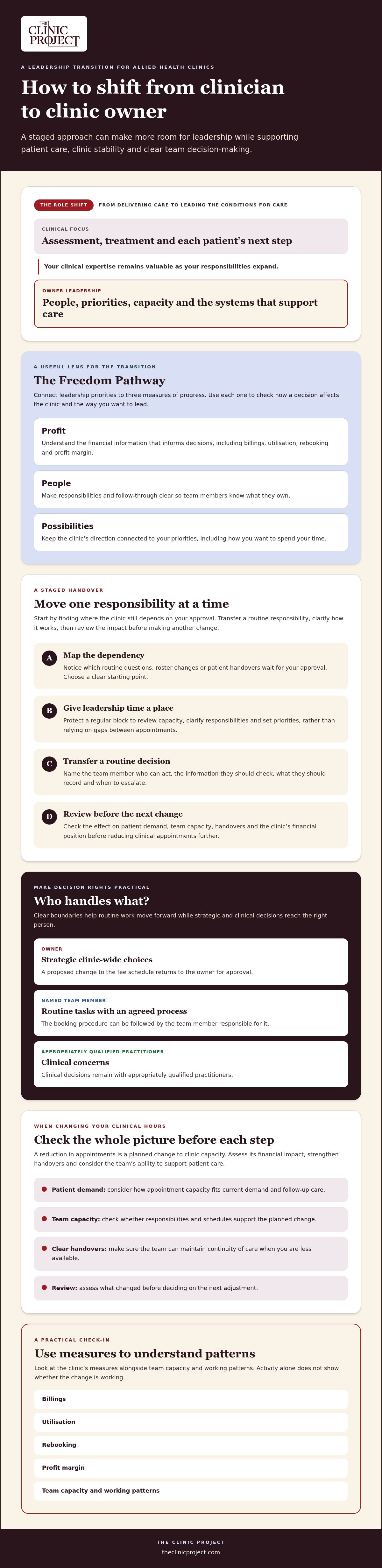
Transitioning from clinician to clinic owner is the deliberate shift from delivering most patient care yourself to leading the people, priorities and systems that support care across the clinic. Your clinical expertise remains valuable, but your responsibilities expand to include decisions about capacity, team roles and the clinic’s direction. Define what you want your role to make possible, then use that priority to guide business decisions.
The Messy Middle is a growth stage when clinic systems can struggle to keep pace and the owner can become a decision bottleneck. Full books and a strong reputation may sit alongside uncertainty about who can approve a roster change or resolve a patient handover. As the clinic grows, defined roles and reliable systems help its structure keep pace with demand.
What changes when a clinician leads an allied health clinic?
Patient appointments focus your attention on assessment, treatment and the next step in each person’s care. Leadership work needs protected time to review appointment capacity, clarify team responsibilities and set priorities. If every roster adjustment waits for your approval, a routine change to cover a physiotherapist’s leave can stall while you’re treating patients. Set a clear decision boundary so the appropriate team member can manage routine roster changes, with an agreed process for exceptions.
Clinical decisions remain with appropriately qualified practitioners. Your leadership role is to create the conditions for them to deliver care well, through clear responsibilities, sound handovers and workable schedules. Health administration describes the leadership and management field that clinic owners also need to engage with.
Why does the shift feel difficult in the Messy Middle?
Clinical work can fill the day, leaving financial review, planning and team conversations for the gaps between appointments. Those gaps rarely allow the attention needed to decide, for example, whether next month’s roster has enough capacity for new referrals while protecting follow-up appointments. Set aside a regular block for leadership work, and identify who can make routine decisions when you are unavailable. Clear ownership helps the team work within a structure designed for the clinic’s needs.
Use the Freedom Pathway to keep your next steps connected to Profit, People and Possibilities. For example, before handing over a roster decision, consider the effect on clinic capacity, whether the team member has the authority and information to act, and whether the change supports the way you want to lead. You won’t be here without strategy, so give leadership time a defined place in the week and a clear purpose.
What strategy and leadership systems support the clinic-owner transition?
Transitioning from clinician to clinic owner becomes more manageable when strategy, decision rights and clinic measures work together. The Freedom Pathway aligns the Scale Sequence with the three pillars of clinic growth: Profit, People and Possibilities. Use the Clinic Scale Pathway to consider your clinic’s revenue and operational stage, then focus on the work that fits that stage rather than copying another clinic’s priorities.
Profit means understanding the financial information that informs decisions, such as billings, utilisation, rebooking and margin. People means clarifying responsibilities and follow-through so team members know what they own. Possibilities keeps the clinic’s direction connected to the owner’s priorities, including how she wants to spend her time. Repeatable systems reduce routine owner approvals and give the team a clear route to action.
Which decisions should remain with the owner?
Keep strategic choices, such as approving a fee schedule change, with the owner. Assign routine tasks, such as following the established booking procedure, to a named team member. Set escalation boundaries: a booking question follows the documented process, while a clinical concern goes to an appropriately qualified practitioner and a proposed change to clinic-wide pricing returns to the owner.
For each delegated decision, document who can act, what information they should check, what they need to record and when they should escalate. This makes the boundary practical, not just a line in a job description. It also helps you distinguish work that needs your strategic judgement from work the team can complete using an agreed process.
How can clinic measures guide decisions?
Use measures to understand patterns, not to assume that activity automatically means progress. Compare billings and utilisation with rebooking and profit margin, and consider the team’s capacity and working patterns when interpreting what you see. If you plan to reduce your clinical hours, record the clinic’s current position first. Then review the same measures after the change, alongside patient-care information and team feedback. This gives you a useful comparison without treating a single month or busy appointment book as proof that the transition is working.
If you want support clarifying leadership priorities and decision ownership, discuss your clinic’s next leadership steps.
How can you reduce clinical hours while protecting revenue and patient care?
Reduce clinical hours through a planned change to capacity and continuity, then review the evidence before making another adjustment. For a clinic owner transitioning from clinician to clinic owner, a staged approach gives the team time to absorb new responsibilities while you protect patient care and consider the business impact.
Before changing your diary, check appointment demand, each practitioner’s capacity and capability, and the financial information available to you. Map which patients need ongoing care with you, who can provide appropriate continuity, and what needs a clinical handover or escalation. Decide in advance when you will review the change and what information would prompt you to adjust the plan.
- Review demand: Check referral flow, waitlists and appointment patterns across the clinic.
- Clarify team capacity: Match patient needs with practitioner availability, capability and current commitments.
- Plan handovers: Identify patients needing a warm transition, documented clinical context or follow-up.
- Make one change: Adjust one defined part of your schedule, and communicate what changes for patients and the team.
- Review: Compare billings, utilisation, rebooking, profit margin and patient-care indicators with the information you recorded before the change.
Illustrative example: If you move a regular clinic session out of your diary, first identify which appointments need continuity with you and which can be booked with another suitably qualified practitioner. Record the handover steps, confirm who handles patient questions and review the relevant measures at your agreed check-in. A busy appointment book alone does not show whether the change supports sound care or a more sustainable business.
For a recurring responsibility such as daily appointment changes, document the task owner, booking steps and escalation boundaries in a handover checklist. Check whether the process works for patients and the team before transferring another task. If you want to plan this transition with Winnie, Book an Impact Call with Winnie.
What is a practical next step in transitioning from clinician to clinic owner?
Start by naming one recurring responsibility you want to move out of your own hands. In an allied-health clinic, that could be approving routine roster adjustments, monitoring unfilled appointments or following up on incomplete patient bookings. Use the Freedom Pathway pillars, Profit, People and Possibilities, to check that the change supports clinic performance, team capability and the life you want your business to make room for.
How do you choose the first change to make?
Choose a bounded task that does not require your personal clinical judgement, carries manageable risk and has a clear process. For example, a capable team member could follow an agreed procedure for routine appointment changes, while clinical concerns and exceptions stay with the appropriate practitioner or owner. Write down the steps, decision boundaries and who handles questions.
Set a review point before handing it over. Check whether the process is reliable, patients are receiving clear communication, and the task is returning meaningful time to you. If any of those checks show a problem, refine the process before transferring another responsibility.
When could external strategic support help?
External perspective can help when you need structure to prioritise decisions, operational design to clarify ownership or leadership planning to protect time for director work. The Clinic Project’s Clinic Scale Pathway can help owners consider their clinic’s revenue and operational stage, while the Scale Sequence provides a step-by-step order for what to work on. The Clinic Project Program includes Strategy Intensives and Set to Scale, with support shaped around the work your clinic needs to address.
For guidance on choosing support, read about allied health business coaching in Australia and allied health practice growth program guidance. A Strategy Intensive can suit an owner seeking focused strategic input. Choose support based on the specific bottleneck you need to address, not on the assumption that every clinic needs the same program.
Transitioning from clinician to clinic owner is a deliberate change in how you lead and where your time goes. Start with strategy, then shift one role or decision at a time.
Make your next leadership move deliberate
Transitioning from clinician to clinic owner works best as a planned change in responsibility, supported by clear roles, repeatable systems and regular review. Start by choosing one routine decision to transfer, then check its effect on team ownership, patient continuity and your time for leadership.
Keep the Freedom Pathway in view: Profit, People and Possibilities. These pillars help you consider whether a change supports sustainable clinic performance, team capability and the opportunities you want your business to create. Use the Clinic Scale Pathway to think about your clinic’s current stage, then choose a next step that fits its needs.
Give that step a clear purpose and a review point, so your role can evolve while the clinic continues to support patients and the team. For a strategic conversation about your clinic’s next move, Book an Impact Call with Winnie.
You can make this transition one considered decision at a time.
Frequently Asked Questions
How do I transition from clinician to clinic owner?
Start by separating clinical responsibilities from leadership responsibilities, then choose one recurring task or decision to transfer safely. Check who on your team has the capability to own it, document the steps and decision boundaries, and set a review point. Keep patient continuity and clinic priorities in view as you adjust. Let the sequence reflect your clinic’s stage, rather than an arbitrary deadline.
Can I reduce my clinical hours without losing clinic revenue?
Revenue after reducing clinical hours depends on clinic demand, team capacity, service mix and your financial position. Review those factors before changing appointments, plan how patients will continue their care, then monitor relevant measures such as billings, utilisation and profit margin. No plan can promise revenue will stay unchanged. Adjust the pace if the information shows the clinic needs more preparation.
What should a clinic owner delegate first?
Start with a recurring, clearly bounded task that does not require your personal clinical judgement. For example, a team member could manage routine roster changes by following documented steps, with clear boundaries for when to escalate an exception. Name the person responsible and explain how to complete the task. Before transferring more complex work, review whether the handover is reliable for staff and patients.
How do I protect patient care when I spend less time treating?
Plan continuity of care alongside any change to your clinical hours. Clarify which practitioner is responsible for each part of care, document handovers and establish how clinical concerns are escalated. Keep practitioner qualifications and professional boundaries clear, then review patient feedback and relevant service information. If the team’s responsibilities or handover process are unclear, resolve those gaps before making a broader schedule change.
Do I need a business program to become a clinic owner?
No single form of support suits every owner, and a paid program is not essential. You can build capability through structured learning, peer input and experience, or seek tailored strategic support when you need help with a specific decision or system. The Clinic Project supports women allied-health clinic owners in Australia, New Zealand, Canada, Hong Kong and Singapore. Identify the need first, then choose the support that fits.

Article by
Winnie Wu
Physiotherapist Winnie Wu builds allied health clinics that are highly profitable and run without their owner. She has founded four health brands. Her two Sydney clinics, Movement Laboratory and the award-winning Papaya Clinic, let her take three to four months off every year. Through The Clinic Project she works directly with women clinic owners on profit, systems and leadership, and her Set to Scale clients average a 32% profit margin, more than double the industry average. Every framework she teaches runs in her own clinics first.