

Hybrid programs

AI can give an allied health clinic more room to focus when it supports a well-defined workflow. If your team spends time drafting routine emails, sorting referral information or preparing patient resources, ai for allied health clinics starts with a practical question: which task could you improve without compromising care?
Caution is sensible. Patient information is sensitive, and a polished-sounding draft can still be inaccurate or impersonal. Clear privacy boundaries and human review help you test a workflow responsibly.
In this article, you’ll learn how to choose a low-risk task, set review boundaries and use your clinic’s own measures to decide whether the process genuinely helps.
Key Takeaways
- Look for suitable starting points for ai for allied health clinics, such as drafting general marketing copy or preparing administrative templates.
- Before using a tool, check how it handles information, how you will review its output and which current privacy and professional guidance applies to your clinic.
- Test one defined workflow and use your clinic’s own baseline, such as admin time or rework, to judge whether it helps.
- Connect AI decisions to a real clinic priority, such as reducing owner approval bottlenecks. You won’t be here without strategy.
Where can AI for allied health clinics help without disrupting care?
AI tools process prompts or data to produce outputs for a defined task. In an allied health clinic, that might mean drafting general marketing copy, organising internal information or preparing an administrative template for a team member to review.
Start with business support that has a clear boundary. For example, a clinic could use an approved tool to group de-identified referral enquiries by topic, helping reception direct them to the appropriate next step. A team member still checks each item and decides how to respond.
Where can ai for allied health clinics support bounded tasks?
Which clinic tasks are suitable starting points?
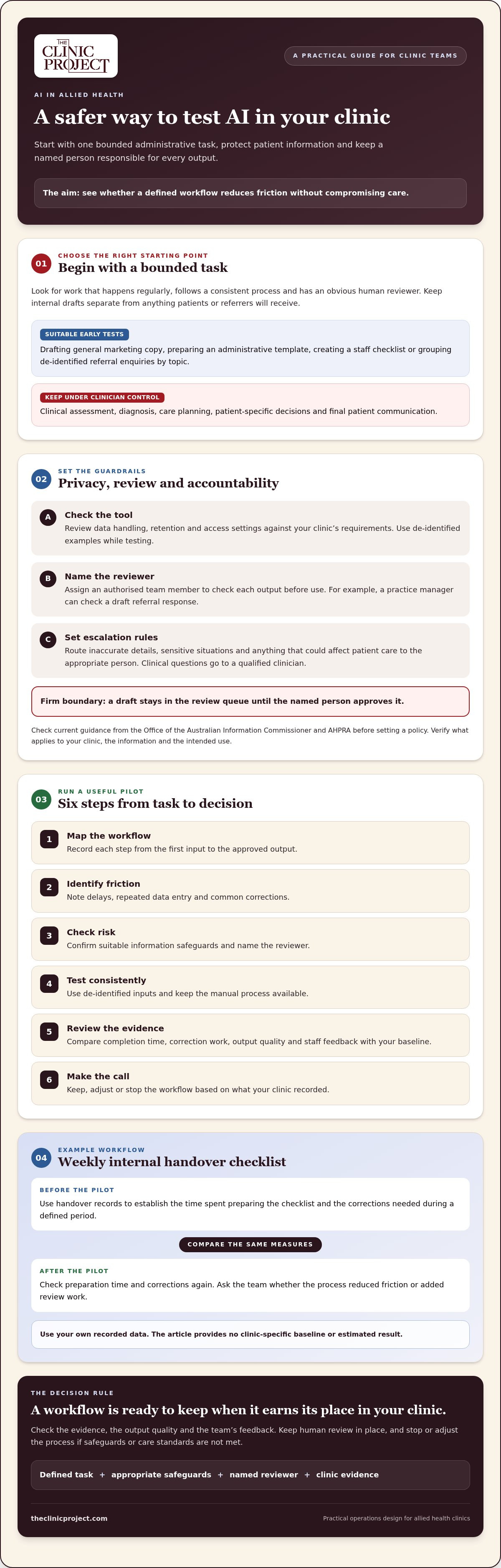
Choose a task that happens regularly, follows a consistent process and has an obvious human reviewer. Keep internal drafts separate from messages patients or referrers will receive. Those messages need careful checking for accuracy, tone and suitability. Suitable early tests include drafting a general social post or preparing a staff checklist.
Don’t enter identifiable patient details until you’ve checked the tool’s suitability and safeguards for that information.
What should remain under clinician control?
Clinical assessment, diagnosis, care planning and patient-specific decisions stay with qualified team members. Clinicians also retain responsibility for final patient communication, including letters and explanations of care.
Generated text can sound confident and still contain errors, omit relevant context or use language that doesn’t fit the patient. A clinician must check any output related to care before it is used. For broader context on applications and ethical questions, see Artificial Intelligence in Healthcare.
Treat AI as one part of deliberate operations design. Start with a defined task, a clear reviewer and a firm boundary around what remains a human decision.
What should allied health owners check before using AI?
Privacy, confidentiality, accuracy and accountability are connected considerations when assessing AI for allied health clinics. Even if a tool handles information appropriately, it still needs a defined reviewer. An accurate-sounding draft can contain errors or expose information in ways your clinic hasn’t approved.
Before a trial, check the tool’s data handling, retention and access settings against your clinic’s requirements. Use de-identified examples while testing. Keep patient details out until you’ve verified suitable safeguards and checked the current requirements that apply to your clinic.
How should a clinic protect patient information?
Review current guidance from the Office of the Australian Information Commissioner and AHPRA before setting a policy or describing legal and professional obligations. Requirements can depend on the information, tool and intended use, so verify what applies rather than assuming one rule covers every workflow. Clinics in Australia, New Zealand, Canada, Hong Kong and Singapore should check the current privacy and professional guidance relevant to their location and intended use.
For tools designed to support clinical functions, the FDA guidance on AI medical devices offers useful background on AI-enabled devices. It’s US guidance, so use relevant local sources to confirm what applies to your clinic.
How can teams review AI-generated material?
A clinician or authorised team member remains responsible for reviewing clinic outputs before use. Name the reviewer for each workflow, whether that’s the practice manager checking a draft referral response or a clinician reviewing patient-facing material. Set clear escalation rules for inaccurate details, sensitive situations and content that could affect patient care.
Write the boundary into the workflow: a draft stays in the review queue until the named person approves it, and clinical questions go to a qualified clinician. You won’t be here without strategy. For support with operational decisions, explore support for clinic owners.
How can you test AI in an allied health clinic?
A useful AI pilot tests one defined administrative workflow against the way your clinic handles it now. For ai for allied health clinics, use your own baseline, output quality and team feedback to decide whether the process helps.
What makes a useful first pilot?
Choose a recurring task with a clear start, finish and owner, such as preparing the weekly internal handover checklist for clinicians and reception. Record the existing steps, approval points and common corrections. Keep the manual process available so clinic operations can continue if the tool proves unsuitable.
- Map the workflow: Record each step from the first input to the approved output.
- Identify friction: Note delays, repeated data entry and corrections.
- Check risk: Confirm the task can be tested with appropriate information safeguards and a named reviewer.
- Test: Use consistent, de-identified inputs and retain the manual fallback.
- Review: Compare completion time, correction work, output quality and staff feedback with the baseline.
- Decide: Keep, adjust or stop the workflow based on the evidence.
For example, use your clinic’s handover records to establish the time spent preparing the checklist and the corrections needed during a defined period. Compare those same measures after the pilot, then ask the team whether the new process reduced friction or added review work. There is no clinic-specific baseline to rely on here, so use your own recorded data rather than estimates.
For structured learning about AI systems for clinic marketing and operations, explore Practical AI for Clinics.
How does AI fit into a clinic's wider operating system?
AI belongs in a clinic’s operating system only when it supports a defined priority. If your main constraint is the owner approving every routine communication, a tool that drafts general internal templates could support delegation. If the priority is patient experience, check whether the proposed workflow improves clarity without weakening personal review or adding work for the team.
A sound approach to ai for allied health clinics connects the tool to an owner, a documented process and a measure the clinic already tracks. For example, if reception prepares a standard follow-up message after an appointment, define who checks the draft, what tone and information it must meet, and how staff will flag anything that needs a clinician’s input.
What should the owner decide before expanding a pilot?
Before adding another workflow, confirm that one team member is accountable for it, review standards are written down and staff know what to do when an output is inaccurate or unsuitable. Then check that the task supports a real priority, such as consistent patient communication or fewer approval steps, rather than introducing another tool for its own sake.
How can strategic support help?
Strategic support can help you map the workflow, clarify operational priorities and set responsible implementation boundaries before expanding a pilot. The Clinic Project’s Practical AI for Clinics is a learning option focused on AI systems for clinic marketing and operations.
If you’re weighing where AI fits in your clinic, start with the task causing the clearest operational friction and bring that workflow into a discussion about your needs.
Choose one workflow and build from there
AI for allied health clinics works best when it supports a real operational priority, with clear privacy boundaries, a named reviewer and measures drawn from your own clinic. Start with one low-risk task, compare the pilot with your existing process and keep clinical judgement with your qualified team.
The Clinic Project works directly with clinic owners to examine workflows and operational priorities. You won’t be here without strategy.
If you’d like to discuss how a considered AI workflow could fit your clinic’s needs, Book an Impact Call with Winnie. Start with the task creating the most friction, then make your next decision using evidence your team can see.
Frequently Asked Questions
Can allied health clinics use AI with patient information?
Only after the clinic has checked the tool, its data handling and the applicable privacy and professional guidance. Don’t assume a tool is suitable for identifiable patient information. Use de-identified material for early testing, check who can access inputs and outputs, and establish review controls. Verify current guidance from authoritative local sources before making a specific claim about compliance or patient information.
Is AI safe to use in an allied health clinic?
Safety depends on the task, the information entered, the tool’s settings and how outputs are reviewed. Keep clinical decisions and patient-specific material under appropriate professional oversight. Before introducing a tool, document its purpose, check how it handles information and name the person responsible for reviewing its outputs. Check current guidance relevant to your location and intended use rather than assuming every AI tool is suitable.
How can AI help an allied health clinic?
AI for allied health clinics can assist with bounded business tasks, such as drafting general marketing material or organising internal administrative information. A team member should check every output before it’s used, especially if patients or referrers will receive it. Start with one repetitive workflow, define what an acceptable result looks like, then compare the process and output quality using your clinic’s own records.
Can AI write clinical notes for allied health practitioners?
AI-generated clinical notes require careful assessment of accuracy, privacy and professional oversight. Don’t enter identifiable patient information until you’ve verified the tool’s suitability and safeguards for that use. The responsible practitioner should check any generated note before it becomes part of a clinical record. Review current professional guidance before introducing AI into documentation, and set a clear process for correcting errors or omissions.
How should a clinic start using AI?
Choose one recurring, low-risk administrative task and document how the team handles it now. Check the tool and its information safeguards, assign a reviewer, and run a limited test with a manual fallback in place. Compare verified clinic measures, such as time spent or correction work, and ask staff whether the process reduced friction. Decide whether to adjust, continue or stop based on that evidence.

Article by
Winnie Wu
Physiotherapist Winnie Wu builds allied health clinics that are highly profitable and run without their owner. She has founded four health brands. Her two Sydney clinics, Movement Laboratory and the award-winning Papaya Clinic, let her take three to four months off every year. Through The Clinic Project she works directly with women clinic owners on profit, systems and leadership, and her Set to Scale clients average a 32% profit margin, more than double the industry average. Every framework she teaches runs in her own clinics first.