

How to Systemise a Private Practice for Scalability

How to systemise a private practice starts with the recurring decisions that keep landing on the owner’s desk. Your appointment book is full, but you’re still approving a roster change at 7pm while clinicians handle patient handovers differently across shifts. Work moves forward, yet every variation and approval returns to you.
The Messy Middle: the growth stage where clinics expand but systems break and owners burn out. You won’t be here without strategy.
I’m Winnie Wu, a physiotherapist, clinic founder and systems architect. I’ve grown two clinic brands while taking three to four months off each year since 2022. Here’s a practical way to clarify workflow ownership, set standards your team can use and build repeatable operations that support patient experience and sustainable profit.
Key Takeaways
- Start with recurring work that creates friction for patients, the team or cash flow.
- Map the workflow, assign an owner and document the steps, handovers and exceptions.
- Set clear standards for enquiries, rebooking, cancellations and follow-up so routine decisions can move forward.
- Review systems through Profit, People and Possibilities, with clear ownership and regular updates.
How to systemise a private practice when you are the bottleneck
Systemisation makes recurring clinic work consistent, owned and easier to review. Full books and capable clinicians can still leave routine decisions funnelled through you, from a roster adjustment to whether a patient needs a follow-up call.
The Messy Middle: the growth stage where inconsistent processes make decisions and handovers dependent on the owner. Clear systems give the team a reliable way to complete repeatable steps while leaving clinical judgement with the treating clinician. They also define when judgement is needed and when a question should be escalated.
What does systemising a private practice mean?
A process works when the person doing the task can find it and follow it during a busy clinic day. A document buried in a folder won’t help a receptionist decide what to do when a new patient enquires about an appointment.
Define each system by its trigger, accountable owner, standard action and escalation point. For example, a patient finishing an initial appointment can trigger a follow-up task. The treating clinician owns the clinical recommendation, while a clear handover tells the admin team what booking action to take. This approach reflects business process management, which involves understanding and improving how work moves through an organisation.
Which owner-dependent patterns signal a system gap?
Track the decisions that keep returning to you. A 7pm message asking you to approve a roster swap, or repeated requests to approve routine follow-ups, points to unclear ownership or a missing decision boundary.
For one week, record who raised each decision, what information they needed and what would let them act next time. I use this pattern as a clinic founder to identify which workflow needs a clear owner and standard. You won’t be here without strategy.
Which allied-health clinic workflows should you systemise first?
Start with recurring work that affects patient experience, owner approvals, cash flow or team coordination. A practical approach to how to systemise a private practice is to trace where work stalls, then document the workflow behind that delay.
How do you choose the first workflow to document?
Map a recent breakdown from its trigger to resolution. For a cancellation, note who receives the message, who updates the appointment, whether the clinician needs to know and who contacts the patient about another time. Mark every handover and approval, including routine questions that landed with you.
Choose a process that happens repeatedly and affects patients or team coordination. Common candidates include enquiry-to-first-appointment, rebooking after a treatment session, cancellation follow-up and billing handovers when a clinician’s notes need an admin action. Retention and patient experience support clinic profitability by helping the team follow up clearly and support appropriate continuity of care.
What should a clinic handover system include?
Every handover needs a named person to record the next action, a consistent place for the team to find it and a clear owner responsible for follow-up. After an appointment, for example, the clinician records the agreed next step and timing in the designated patient record, then assigns any booking action to the admin team. The clinician retains responsibility for clinical recommendations; admin staff own the booking task.
The practice manager coordinates the process and monitors gaps, while you set the standard and review how it works. The practice manager is the owner’s most important hire because the role can hold operational ownership across rosters, handovers and follow-up. Patient-centred workflows are core clinic infrastructure, as this strategy for value-based health care also illustrates.
If you want to talk through the systems shaping your clinic, you can discuss your operational priorities with Winnie.
How to systemise a private practice with a practical checklist
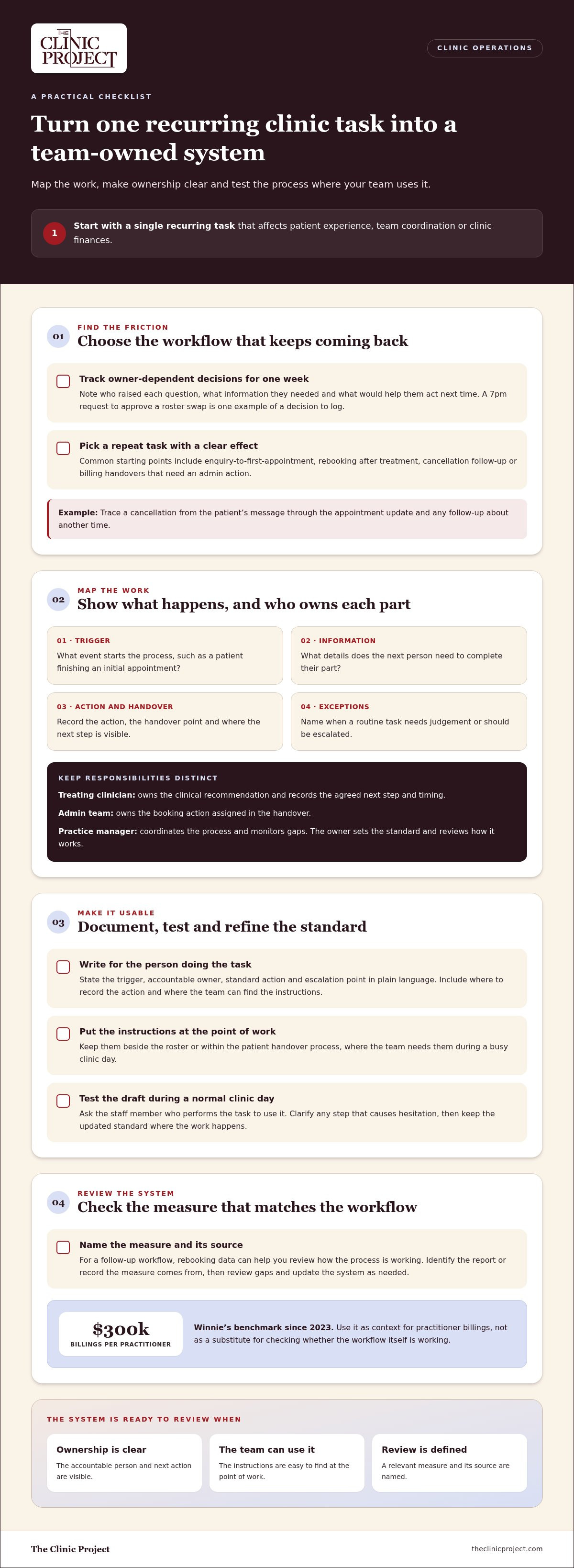
Turn one recurring clinic task into a sequence your team can follow and review. Start with a patient handover or roster change, then use this checklist:
- Choose one process: Pick a recurring task with a clear effect on patients, team coordination or clinic finances.
- Map the steps: Record the trigger, information needed, action, handover, likely exceptions and escalation point.
- Assign an owner: Name the person accountable for completing the process and keeping the next action visible.
- Document the standard: Explain in plain language what to do, where to record it and when to escalate.
- Test and refine: Ask the staff member who performs the task to use the draft during a normal clinic day, then clarify any step that causes hesitation.
Keep instructions where the work happens, such as beside the roster or within the patient handover process. Allied health depends on operational infrastructure as well as clinical expertise, and a usable process connects the two.
How do you make a written process usable for the team?
Write for the person completing the task, not for a policy folder. A receptionist handling a cancellation needs to see who updates the appointment, where the patient’s next action is recorded and who follows up if the patient doesn’t rebook. In my clinics, Movement Laboratory and Papaya Clinic, I build standards around the point of work so they can guide the team during a busy clinic day.
How can you review whether the system is working?
Choose a measure that matches the process, then name the report or record it comes from. Rebooking data can help you review a follow-up workflow; a financial measure can inform a broader review of clinic performance. My benchmark since 2023 has been $300k billings per practitioner. Use it as context for practitioner billings, not as a substitute for checking whether the workflow itself is working.
You can bring your clinic’s systems questions to Winnie if you want to discuss a practical next step.
Keeping private practice systems useful as the clinic grows
A clinic system stays useful when ownership and review are clear. The Messy Middle: the growth stage where owner approvals and inconsistent processes shape daily work. Clinic on Autopilot: a stage where the team owns repeatable workflows and the owner reviews performance without approving each routine action.
- Messy Middle: You approve routine roster changes, processes vary between clinicians and problems reach you before they are reviewed.
- Clinic on Autopilot: A named team member owns the roster process, staff follow the agreed standard and exceptions are escalated through clear boundaries.
Busyness alone does not show that a clinic is growing well. Review a system through Profit, People and Possibilities: does it support sustainable profit, make responsibilities workable for the team and leave room for considered future choices?
How often should a clinic review its systems?
Review a workflow when it changes, ownership shifts or recurring errors show that the instructions need revision. Assign a named owner to keep the process current and gather feedback from the people using it. If a roster handover changes, update the steps where the team checks the roster rather than relying on a verbal reminder.
How can the owner step back without losing oversight?
The CEO Workflow: a way to organise owner responsibilities around energy peaks and fixed commitments. Set review time for the roster, financial measures and operational exceptions, then give routine decisions to their named owners. In my clinics, clear ownership and scheduled review keep the owner’s attention on the decisions that need it. For a staged approach to changing your clinical workload, read How to Get Off the Tools: A Staged Plan for Allied Health Clinic Owners.
That is how to systemise a private practice while keeping oversight connected to the work. If you want to talk with Winnie about the systems shaping your clinic’s next stage, start a conversation here.
Build clinic systems that give you room to lead
Start with one recurring workflow, give it a clear owner and review whether it supports patients and the team. Strong systems make everyday work more consistent while keeping clinical judgement where it belongs.
Choose processes that repeatedly require your approval, such as patient follow-up or roster changes. Document the trigger, next action and escalation point so the team can move work forward without waiting for you to decide each step.
Inside Set to Scale, members average a 32% profit margin against an industry average of around 15%. These figures describe the program’s reported averages, not a promise of any particular outcome. A deliberate operational design gives you a clearer basis for reviewing how your clinic works.
Start by choosing one workflow your team can own, then make the next action and escalation point clear. You can discuss your clinic’s systems with Winnie.
Frequently Asked Questions
How do you systemise a private practice?
Start with one recurring clinic process and make its trigger, owner, steps and escalation point clear. For example, map what happens after a patient finishes an appointment, including how the clinician records the next action and how the admin team follows up. Test the written process with the person doing the work, then review it when responsibilities change or repeated errors appear.
What systems does an allied-health clinic need first?
Prioritise workflows that affect patients, cash flow or team coordination. Common starting points include managing enquiries through to a first appointment, rebooking, cancellations, billing handovers and patient follow-up. Choose the process that repeatedly stalls or needs owner approval, then clarify who owns each step. For clinics in Australia, New Zealand, Canada, Hong Kong and Singapore, make the local billing and funding context clear within the workflow.
How do you get your team to follow clinic processes?
Make each process easy to find and practical to use during a clinic day. Write the next action in plain language, name the person responsible and place the instructions beside the work, such as near the roster or in the handover workflow. Ask the staff member who performs the task to test the draft and flag unclear steps. The owner remains responsible for setting standards and reviewing how they work.
Can systemising a clinic improve patient experience?
Clear systems support a more consistent patient experience by helping the team complete follow-up, booking and handover steps reliably. A documented process can show who records a recommended appointment and who contacts the patient to arrange it. Clinical judgement stays with the treating clinician, and patient-facing workflows need clear ownership as well as sound clinical decisions.
How do you know whether a clinic system is working?
Choose a measure that matches the workflow and use a consistent source to review it. Rebooking data can help assess a follow-up process, while a financial measure can inform a broader review of clinic performance. Look for recurring errors, missed handovers and decisions returning to the owner, then update the process when its steps or ownership no longer fit the way the clinic operates.

Article by
Winnie Wu
Physiotherapist Winnie Wu builds allied health clinics that are highly profitable and run without their owner. She has founded four health brands. Her two Sydney clinics, Movement Laboratory and the award-winning Papaya Clinic, let her take three to four months off every year. Through The Clinic Project she works directly with women clinic owners on profit, systems and leadership, and her Set to Scale clients average a 32% profit margin, more than double the industry average. Every framework she teaches runs in her own clinics first.