
The Power of Allied Health Peer Mentoring for Directors

Allied health peer mentoring helps clinic owners make clearer decisions by turning shared experience into structured leadership practice. When roster changes, fee decisions and team questions keep coming back to you, a full clinic can bring more operational pressure without giving you more freedom.
You already know that running a clinic takes more than clinical expertise. It also means leading people, managing different funding streams and making decisions that affect your team and patients. You won’t be here without strategy. In my work as a clinic founder and allied health strategist, I’ve seen the value of testing a decision with people who understand the realities of clinic ownership.
Useful peer mentoring turns those conversations into practical next steps and stronger leadership habits. Here’s how to bring a live clinic decision to the table, make the discussion useful and decide whether the format fits your practice.
Key Takeaways
- Allied health peer mentoring gives clinic owners a structured way to test decisions with people who understand practice ownership.
- Bring one specific clinic issue, explain the relevant context and leave with a practical action to review.
- Use a clear process to turn a handover or scheduling bottleneck into a change your team can implement.
- Match the support to your need, whether that is peer perspective, accountability, strategic direction or specialist advice.
What does allied health peer mentoring offer a clinic owner?
Allied health peer mentoring is structured learning between clinic owners with relevant experience. Even with a full appointment book, the director can still be carrying every consequential decision, from approving a roster adjustment to sorting out a handover gap that affects patient continuity. A peer who understands clinic ownership can help you examine assumptions about team capacity, leadership responsibilities and the patient experience.
Allied health peer mentoring: a working definition
In practice, peer mentoring is reciprocal, structured reflection on business decisions, leadership and operational patterns. Clinic owners bring a defined issue, compare perspectives and identify what they will take back to their own practice. The professions represented across allied health are varied; AHPRA’s information on regulated health professions offers one view of that professional landscape.
Peer mentoring differs from clinical supervision, which centres on clinical practice, and professional networking, which can focus on making connections. One-to-one strategic advice brings a specialist perspective to your business. Peer mentoring adds reciprocal challenge from owners who are accountable for teams, patient experience and clinic operations.
Why clinic owners value a peer perspective
A peer can recognise the tension between practitioner capacity and continuity of care without reducing it to generic advice about hiring or productivity. If a practitioner’s schedule is full but follow-up is slipping after a change of working days, for example, peers can help you look at the handover, appointment availability and how the team communicates the change.
I founded Movement Laboratory and Papaya Clinic, and I bring that experience as a clinic founder to my work as an allied health strategist. A peer discussion can help you return to your team with a clearer rationale for a decision. You remain responsible for choosing and implementing the next step.
What makes allied health peer mentoring useful rather than another meeting?
Effective peer mentoring connects a specific clinic decision to a clear next step. To earn a place in your diary, the discussion needs focus, relevant experience and an agreed action. Without those boundaries, a conversation can feel supportive while leaving you with the same unresolved choice.
How to create a focused mentoring conversation
Bring one live decision, the practical constraints and the outcome you need. If you’re deciding whether to extend evening appointments, explain the patient demand, practitioner availability and effect on the existing roster. Ask peers to share comparable experience, then separate what they observed in their own clinics from what they recommend for yours.
- State the decision you need to make.
- Share the context that affects the options.
- Invite peers to test your assumptions and identify trade-offs.
- Record the action you’ll take and when you’ll review it.
Supportive listening gives you space to think aloud and name what feels difficult. Structured challenge adds useful questions, such as whether the proposed hours match patient demand or create pressure elsewhere in the roster. A skilled facilitator keeps both forms of contribution respectful, specific and relevant to each owner’s circumstances.
When a peer perspective has limits
Peers can inform your judgement, but they don’t replace specialist clinical, legal, financial or employment advice. If a discussion raises a question about clinical care, a contract, cash flow or a team member’s employment, identify that boundary and seek advice suited to the issue. The group can help you clarify the decision and the questions that need expert input.
For established clinic owners seeking tailored mentoring alongside peer collaboration, Impact Mastermind peer collaboration provides a structured setting for strategic discussion.
How can you turn peer mentoring into action inside an allied health clinic?
Peer discussion becomes useful when you bring a real clinic decision and leave with an action someone owns. A practical process keeps the conversation grounded in the people, schedules and patient experience affected by the decision.
Prepare a clinic decision for peer discussion
Describe the current process, the decision you need to make, who it affects and which constraints matter. A handover bottleneck, for instance, could mean a patient’s follow-up plan is not reaching the practitioner covering their next appointment. Explain how handover currently happens, where information is missed and what continuity of care needs to be protected.
Ask peers to identify assumptions before offering solutions. Invite examples from clinics with comparable team structures or appointment patterns, then decide which observations apply to your own context. A useful discussion distinguishes between an idea that worked elsewhere and a process your team can actually sustain.
Convert discussion into a system
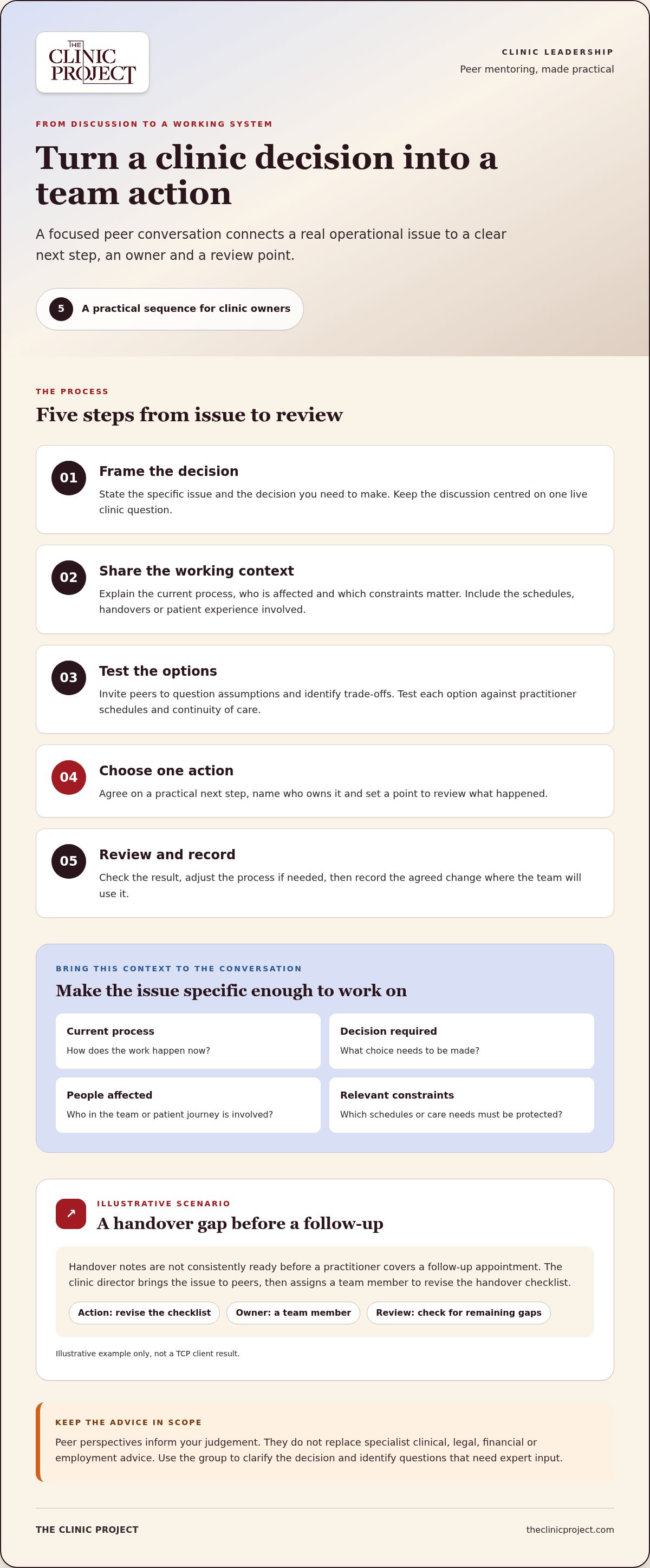
Move through the decision in order:
- Frame the specific issue and the decision required.
- Share the current process, people affected and constraints.
- Test options against practitioner schedules and patient continuity.
- Choose one action, name its owner and set a review point.
- Review what happened and record any adjustment to the process.
Hypothetical scenario: A clinic director notices that handover notes are not consistently ready before a practitioner covers a follow-up appointment. After peer discussion, the director assigns a team member to revise the handover checklist. The team reviews the checklist at a suitable point and adjusts the process if gaps remain. This is an illustrative example, not a TCP client result.
Record the agreed change where the team will use it, such as in the checklist, roster notes or a regular team meeting. In my work as a clinic founder and allied health strategist, I focus on making sure discussion informs how the clinic operates. For established owners looking for a structured setting to work through a leadership challenge, Impact Mastermind brings together strategic mentoring and peer collaboration.
When is allied health peer mentoring the right next step?
Allied health peer mentoring is useful when you need perspective from clinic owners who understand the decisions behind a full roster, patient continuity and team leadership. The right support depends on what is holding the decision in place: a need to think it through, follow-through, strategic direction or advice from a specialist.
Choose the kind of support that matches the decision
Use a peer room to reflect on strategic questions grounded in clinic ownership, such as how to redistribute decisions when every roster adjustment still comes to you. A one-to-one discussion is suited to targeted diagnosis when you need close attention to your clinic structure. Both approaches can support sound leadership; choose the format that matches the question in front of you.
The Clinic Freedom Framework: a way to understand the stages of clinic ownership. The Messy Middle is the growth stage where a clinic has expanded, yet systems and decisions still rely heavily on the owner. If you’re carrying the final approval for leave cover, patient follow-up and practitioner schedules, peer perspective can help you identify patterns and test what to change.
Clinic owners in Australia, New Zealand, Canada, Hong Kong and Singapore can bring different funding and operating contexts to these conversations. Make those local details part of the discussion, particularly when comparing appointment models, patient pathways or team responsibilities.
Bring strategy into the conversation
You won’t be here without strategy. Name the clinic outcome you want, then identify the decision that needs attention. If your aim is to improve patient continuity, specify whether the immediate issue is the handover process, the roster or who can approve a change without you. That gives the discussion a practical centre and helps you choose a next step that fits your clinic.
For established owners seeking tailored mentoring alongside peer collaboration, Impact Mastermind provides a structured setting for strategic leadership discussions. Read Impact Mastermind: Why Australian Clinic Owners Join to understand the format, or discuss your current leadership challenge with Winnie.
Make your next leadership decision with support
Choose a leadership decision that would benefit from an outside perspective, then be specific about the outcome you want for your clinic. A focused conversation can help you decide what needs your attention and what your team can carry forward.
As an allied health strategist and clinic founder, I work directly with clients on decisions shaping their practice. For established owners, Impact Mastermind offers a structured setting to work through leadership questions with peer collaboration.
If you’d like to discuss the decision in front of you, book an Impact Call with Winnie. Bring the challenge you want to clarify and leave with a practical next step to consider.
Frequently Asked Questions
What is allied health peer mentoring?
Allied health peer mentoring gives clinic owners a deliberate way to learn from other health practice leaders’ decisions and operating experience. It can help you compare how different clinics handle a management question, then decide what fits your team and patient model. For example, a director could examine how approval pathways affect responsiveness while retaining accountability for the final decision.
How is peer mentoring different from clinical supervision?
Peer mentoring addresses clinic leadership and business decisions, while clinical supervision focuses on clinical practice and professional reflection. A discussion about how to delegate authority for patient follow-up belongs in a leadership conversation; a question about clinical judgement belongs in an appropriate clinical setting. Naming the question first helps you choose support that matches the issue and keeps each conversation within its purpose.
Can peer mentoring help an allied health clinic owner who feels like the bottleneck?
Yes, it can help you examine why routine decisions still depend on your approval. If staff wait for you to authorise routine supply orders, for example, peers can help you explore the decision boundary, the information the team needs and what should still come to you. You remain responsible for deciding what authority to delegate and how to communicate that change.
How do you make a peer mentoring session practical?
Arrive with one decision and a short written note about the context, constraints and outcome you want. During the discussion, capture useful questions separately from suggestions so you can judge them against your clinic’s circumstances. Before you finish, add the agreed action to the relevant meeting agenda or operations document, name its owner and record when you’ll review it.
Is peer mentoring suitable for every allied health clinic owner?
It suits owners who want to examine leadership decisions with people familiar with running a health practice. The value of peer input depends on how closely others’ operating contexts match your own; owners in Australia, New Zealand, Canada, Hong Kong and Singapore can face different local settings. For clinical, legal, financial or employment questions, seek advice from the relevant specialist.

Article by
Winnie Wu
Physiotherapist Winnie Wu builds allied health clinics that are highly profitable and run without their owner. She has founded four health brands. Her two Sydney clinics, Movement Laboratory and the award-winning Papaya Clinic, let her take three to four months off every year. Through The Clinic Project she works directly with women clinic owners on profit, systems and leadership, and her Set to Scale clients average a 32% profit margin, more than double the industry average. Every framework she teaches runs in her own clinics first.