

Allied Health Business Coaching in Australia: How to Choose the Right Coach

The coach promising the fastest growth isn’t necessarily the right one for your clinic. If you’re looking for allied health business coaching in Australia, ask whether a coach understands the pressures of a clinician led practice and can help you make practical, sustainable progress.
When you’re balancing patient care, staff needs and daily operations, business decisions can become reactive. You may know something needs to change but be unsure what to prioritise, or whether general business advice will fit your clinic. It usually means you need clearer structure and support that reflects how allied health businesses operate.
This article offers a practical way to define the challenge you want coaching to address, compare providers’ experience and working methods, and assess how they support accountability. You’ll also consider which format suits your goals and capacity, so you can choose based on fit rather than bold promises. The aim is a workable approach that helps you make progress without adding unnecessary complexity.
Key Takeaways
- Name the business challenge you want coaching to address, then define what practical progress would look like.
- When comparing allied health business coaching options, look for relevant clinic experience, a clear method and meaningful accountability.
- Use testimonials and case studies as context, not as a promise that your clinic will achieve the same results.
- Match the level of support to your priorities, the complexity of the challenge and your capacity to put changes into practice.
- Compare support formats, including structured programs, masterminds and strategic intensives, against your needs and goals.
When does allied health business coaching make sense for your Australian clinic?
Your clinical work may be why you built the clinic. Running it also means making commercial decisions, supporting a team and keeping daily operations moving. When those responsibilities compete for your attention, it can be difficult to step back and work out what needs to change first.
Allied health business coaching provides structured support for business decisions, leadership and implementation. It can help you clarify priorities and decide how to act on them. The term Allied health professionals covers a broad range of professions, and clinics differ in their services, teams and operating realities. Your search should help you find support suited to your kind of practice, not just general business advice.
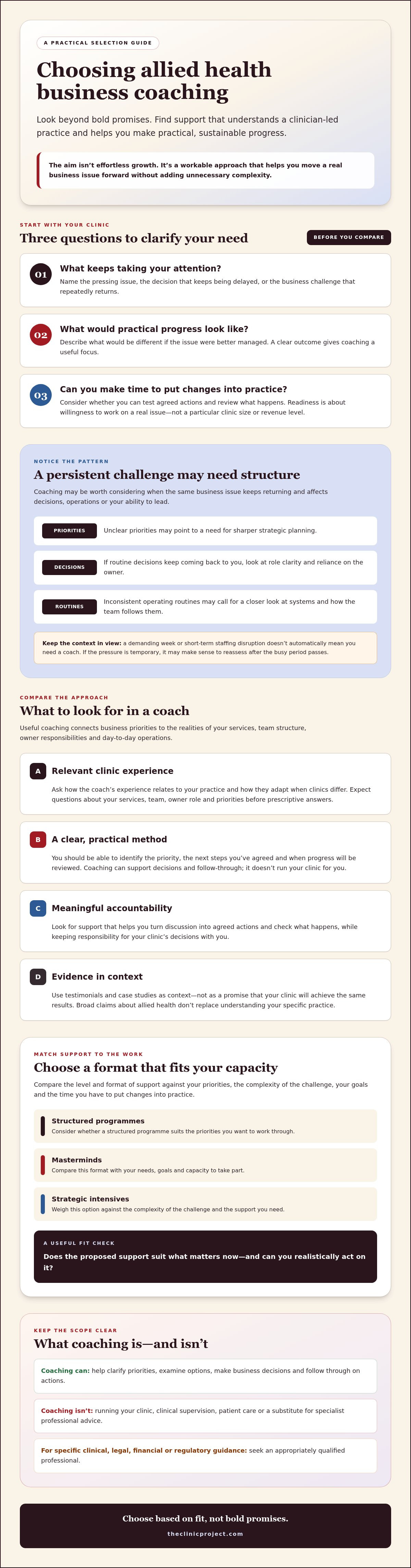
Coaching may be worth considering when the same business challenge keeps returning, rather than during a temporary busy spell that may settle with time. A demanding week or short term staffing disruption doesn’t automatically mean you need a coach. Look for a persistent pattern that affects decisions, operations or your ability to lead.
What problems can an allied health business coach help you work through?
Start with what you’re noticing, without assuming you already know the cause. Unclear priorities might point to a need for sharper strategic planning. If routine decisions keep coming back to you, the issue may involve role clarity or too much reliance on the owner. If operating routines are inconsistent, take a closer look at the systems in place and how the team follows them.
A coach should help you examine options, make decisions and follow through. They don’t take responsibility for running your clinic, and coaching isn’t clinical supervision, patient care or a substitute for specialist professional advice. For clinical guidance or advice on a specific legal, financial or regulatory matter, seek an appropriately qualified professional.
Is your clinic ready to benefit from coaching?
Readiness isn’t defined by a particular clinic size or revenue level. It’s about being willing to work on a real business issue and make time to act. Before speaking with a coach, write down:
- The pressing issue: What keeps taking your attention or delaying a decision?
- The change you want: What would be different if this issue were better managed?
- Your capacity to implement: Can you make time to test agreed actions and review what happens?
You don’t need a perfect plan before seeking support. But if you can name the challenge and are prepared to take part in the work, you’ll have a clearer basis for deciding whether coaching is a useful next step. If the pressure is temporary, it may make sense to reassess once the busy period passes.
What should allied health business coaching actually address?
Useful coaching connects business priorities to the realities of a clinician led practice. A clinic’s services, team structure and owner’s clinical commitments all affect which changes are workable. A strategy that looks sound on paper may not suit your clinic’s capacity or day to day operations.
Depending on your needs, coaching may help you sharpen strategic priorities, choose business measures to monitor, strengthen operating routines or develop your leadership approach. The goal is to identify what matters now, make an informed decision and turn it into actions that suit your clinic.
How should a coach understand your clinic before recommending changes?
Expect thoughtful questions before prescriptive answers. A coach should explore your services, team structure, responsibilities as owner and the business priorities you’ve identified. If relevant to your clinic, they might also ask how funding arrangements or referral pathways affect operations. These questions help establish context, but they don’t prove universal expertise across allied health.
Ask how the coach’s experience relates to your practice and how they adapt their approach when clinics differ. Allied Health Professions Australia provides an industry level reference point for the Australian allied health sector. A coach should still explain how they’ll understand your specific clinic rather than relying on broad claims about the sector.
What does practical coaching support look like?
Practical support creates a clear path from discussion to action. You should be able to identify the priority you’re working on, the next steps you’ve agreed, when progress will be reviewed and how you’ll adjust if circumstances change.
A framework can be useful, but a generic template delivered without context may not address the underlying issue. For example, a meeting routine only helps if it fits your team’s roles and supports the decisions those meetings need to make. Coaching should make tools relevant to your clinic, not add process for its own sake.
- Strategic clarity: Narrow competing priorities to a manageable focus.
- Business measures: Decide what information will help you assess progress.
- Operational structure: Clarify routines, responsibilities and decision points.
- Leadership: Strengthen how you communicate priorities and guide the team.
Implementation remains a shared process. A coach can question assumptions, offer structure and help you review progress, but you and your team need to test and carry out the agreed actions. For decisions involving clinical practice, finance, law or regulation, seek advice from an appropriately qualified specialist. Coaching supports business thinking; it doesn’t replace that expertise.
You can review The Clinic Project’s allied health business support alongside other providers, then compare each approach with your priorities.
How to compare allied health business coaches before you commit
A coach’s sector experience matters, but it’s only one part of the decision. Compare how they understand your clinic, structure the work and help you follow through. When weighing up your options, look for specific explanations rather than broad claims that one method suits every practice.
| What to compare | What to look for |
|---|---|
| Sector understanding | Relevant experience with clinics like yours, plus thoughtful questions about your services, team and business context. |
| Method | A clear explanation of how priorities are identified and turned into practical actions. |
| Access | Clarity about session format, communication between sessions and expected response times. |
| Accountability | Agreed follow up and review points to check progress and adjust actions. |
| Fit | An approach and working relationship suited to your goals, decision making style and capacity. |
Use testimonials and case studies to understand other clients’ experiences, not to forecast your results. Ask what the example involved, whether that clinic’s circumstances were comparable and what work the owner contributed. Be cautious of claims that imply a particular outcome is assured.
What questions should you ask a prospective coach?
Ask how they learn about a clinic before recommending priorities, and what support is included between sessions. Clarify how implementation is reviewed, what communication they expect from you and how confidentiality is handled. Ask how they respond when an issue falls outside their expertise, including whether they’ll recommend advice from another appropriately qualified professional.
These questions help you understand the working relationship before you commit. The answers should make responsibilities, boundaries and follow up clear, rather than leaving you to guess what happens after a session.
How do coaching, consulting and peer groups differ?
Coaching generally supports your thinking, decisions and follow through. Consulting, where offered, may focus more directly on analysing a business issue or providing recommendations. A peer group brings perspectives from other owners, who can share how they approach similar decisions. Some formats combine these elements, so ask what the provider actually delivers. If you’re considering peer support, a dedicated comparison of mastermind formats can help you assess that option separately.
There’s no single best format. Decide whether you need structured reflection, direct analysis, peer perspectives or a combination, then confirm exactly what’s included before proceeding.
How to decide whether an allied health business coach is the right fit
A good fit depends on more than a coach’s credentials or a polished program outline. Use this four step check to see whether their approach matches your clinic’s priorities and your capacity to act.
- Name the challenge. Describe the recurring issue in plain terms, such as decisions bottlenecking with you or team routines being hard to maintain.
- Define the change. What would you like to be different? A clearer decision making process is more useful than a broad goal to “grow”.
- Test provider fit. Ask how the coach would learn about your clinic before suggesting an approach. Explore what’s included, how progress is reviewed and what happens if your needs change.
- Confirm implementation capacity. Be realistic about the time and attention you can give the work between sessions. A plan that assumes spare capacity you don’t have may be hard to sustain.
Match the support to the issue. A focused, clearly defined priority may call for a contained approach, while connected challenges involving operations, leadership and planning may need more sustained support. Urgency matters, but pressure alone isn’t a reason to commit quickly. Good business coaching should help you assess fit and scope before you decide, not rely on generic advice or urgency to make the decision for you.
What are the signs a coach may not be the right fit?
Pause if a provider guarantees results, pressures you to commit or recommends changes before understanding your clinic. It’s also a concern if they can’t clearly explain their process, scope or accountability. Pay attention to the conversation: can you raise doubts and discuss sensitive business issues candidly, or do you feel pushed towards a preset answer?
Clear boundaries matter. A coach should explain what their support covers and how they handle questions outside their expertise, including when another specialist may be more appropriate.
How can you prepare to get value from coaching?
Bring a short list of current priorities, relevant business information and examples of decisions or issues that keep recurring. You don’t need a perfect diagnosis. Concrete examples help you and the coach focus on what’s happening in practice.
Before agreeing to actions, decide what you can realistically commit to between sessions. Review progress against the agreed steps: what you tried, what changed and what needs adjusting. This is more useful than judging value by how busy you felt.
When you’ve identified a clear priority, review The Clinic Project’s support options alongside your goals and capacity.
Choosing your next step with The Clinic Project
Once you’ve named the business issue, the next step is a considered conversation, not an automatic commitment. Describe what’s happening, what you’d like to change and what you can realistically implement. Then compare the provider’s approach with your priorities, including how the work will be scoped and reviewed.
The Clinic Project was founded by Winnie Wu, a physiotherapist who runs two Sydney clinics, Movement Laboratory and Papaya Clinic. Its support formats are designed for different needs, so consider which one, if any, aligns with your clinic’s current priorities. Exploring your options should help you find a suitable fit, rather than persuade you that every clinic needs the same program.
Which kind of support may suit your current priorities?
Consider the work you need, rather than choosing by format alone. The Clinic Project offers a membership program, a mastermind, 1:1 strategy work, self-paced courses, events and a retreat.
- Set to Scale: A foundational growth program for building robust systems and streamlining day to day clinic operations.
- Impact Mastermind: A high level mastermind for established owners focused on strategic expansion, leadership development and peer collaboration.
- CEO Weekend: An intensive workshop focused on executive strategic planning and working on the business rather than in it.
- The Strategy Consult: A 90-minute 1:1 session with Winnie to diagnose your main bottleneck and build a growth plan.
- Hybrid Fast Track: A self-paced course to create and sell a hybrid program in four weeks.
- Clinic Owners Retreat: An in person strategic retreat for clinic leaders to step away from clinical duties and focus on growth.
These are options, not a progression every owner needs to follow. A clinic strengthening its operating foundations may have different needs from an established practice considering expansion. Ask what each format involves and how it relates to the challenge you’ve identified.
What should you clarify before taking the next step?
Use an initial discussion to check alignment. Explain your goals, then ask how the provider defines the scope of support, what they expect from you and how progress will be reviewed. Clarify what follow up or implementation guidance is included, and how the approach can adapt if your priorities shift.
Confirm current program details directly with The Clinic Project before deciding. Make sure you understand the format and expectations, and that they match the time and attention you can give the work. A clear conversation should help you judge fit, whether or not you proceed.
If one of these options matches your clinic’s priorities, find out more about The Clinic Project’s support options.
Choose support that fits the clinic you’re building
The right coaching relationship should bring focus to a real business priority and help you work through it with clear expectations. Ground your decision in fit, scope and the time you can commit, not promises of effortless growth. That’s a practical way to assess allied health business coaching in Australia and choose support that respects the demands of a clinician led practice.
The Clinic Project, founded by allied health business strategist Winnie Wu, provides tailored business coaching and strategic consulting for physiotherapy, psychology, speech therapy and multidisciplinary practices across Australia. Its options include structured growth programs, masterminds, intensives and retreats, with different formats for different priorities. Review what’s available, then clarify your goals and questions before deciding whether an option suits your clinic.
Explore business coaching and strategic support for allied health clinics with The Clinic Project and start with the priority you want to address.
Frequently Asked Questions
What does an allied health business coach do?
An allied health business coach helps you make and implement decisions about running your clinic. Depending on your needs, support may cover priorities, business measures, systems, leadership and operational challenges. The coach provides structure and guidance, but you remain responsible for decisions and implementation. Coaching isn’t clinical supervision, patient care or a substitute for specialist financial, legal or regulatory advice.
How do I choose an allied health business coach in Australia?
Choose a coach whose experience and approach fit your clinic, not just one with persuasive growth claims. Ask how they’ll understand your services, team and priorities before recommending action. Clarify what support is available between sessions, how progress is reviewed, what falls within their scope and how confidentiality is handled. In allied health, sector familiarity should be backed by relevant questions, not just broad claims of expertise.
Is business coaching useful for a small allied health clinic?
A small clinic may benefit if its owner has a clear business challenge and is ready to work on it. You don’t need to reach a particular revenue level before considering support. For example, coaching could help you clarify operating routines or decide which priorities deserve attention. First check whether the coach’s format suits your needs and whether you have capacity to put agreed actions into practice.
What is the difference between a business coach and a consultant for a clinic?
A business coach generally helps you think through decisions, identify actions and maintain follow through. A consultant may focus more directly on analysing a business issue and providing recommendations, where that service is offered. Some providers combine approaches, so ask what they’ll do in practice. A useful conversation should clarify whether you’ll mainly receive questions and accountability, direct analysis, recommendations or a mix.
How long does allied health business coaching take?
There’s no single timeframe that suits every clinic. It depends on the challenge, the support format and how much implementation the work involves. A focused strategic discussion differs from ongoing support for connected priorities such as systems and leadership. Before committing, ask about the program’s current duration, session structure, follow up and review points. Confirm current details directly with the provider rather than assuming all coaching follows the same schedule.
Can a business coach help me spend less time treating patients?
A coach may help you examine how owner responsibilities, team roles and operating systems affect your clinical workload. For example, you could review which business decisions rely on you and identify routines that need clearer ownership. That work may inform changes to how you spend your time, but it can’t guarantee fewer clinical hours. Any changes should account for your clinic’s needs and your professional responsibilities.
What should I prepare before speaking with an allied health business coach?
Bring one pressing business issue, the change you’d like to see and a few examples of decisions or problems that keep recurring. Relevant information about your services, team structure and current priorities can make the discussion more specific. You don’t need a polished plan. Consider how much time you can realistically commit between sessions, then ask about scope, follow up and how progress will be reviewed.

Article by
Winnie Wu
Physiotherapist Winnie Wu builds allied health clinics that are highly profitable and run without their owner. She has founded four health brands. Her two Sydney clinics, Movement Laboratory and the award-winning Papaya Clinic, let her take three to four months off every year. Through The Clinic Project she works directly with women clinic owners on profit, systems and leadership, and her Set to Scale clients average a 32% profit margin, more than double the industry average. Every framework she teaches runs in her own clinics first.