

How to Get Off the Tools: A Staged Plan for Allied Health Clinic Owners

It’s 7pm and your phone lights up. A patient wants to move tomorrow’s appointment, a physio needs cover for Friday, and nobody else in the clinic feels they can say yes. You’ve just finished your last patient, and your second shift is starting.
If you want to get off the tools and actually run your clinic, this is where the work begins. Your diary only frees up once those decisions stop landing on you, which means the handover has to come before the roster changes. This is the order I teach inside Set to Scale and the order I run in my own clinics.
Key Takeaways
- Hand over roster changes and appointment moves before you cut a single clinical session.
- Give every recurring decision one named owner, a written limit and a clear escalation route.
- Check team utilisation first. If your associates are already above 85%, your appointments have nowhere to go.
- Drop one session at a time and review after four weeks before you drop the next.
Why does cutting clinical hours first backfire?
When an owner decides to step back, the diary is the obvious place to start, because it’s the part you can see. The trouble is that the decisions don’t leave with the appointments. Staff still message you about cover, patients still ask for you by name, and the hours you freed up get eaten by the interruptions you never handed over.
This is the classic Messy Middle problem. The Messy Middle: the growth stage where the clinic has outgrown the owner doing everything, but nothing has been properly handed over yet. Getting off the tools is how you move from the Messy Middle into Clinic on Autopilot, the next stage of the Clinic Freedom Framework, and it only holds when ownership moves before the hours do.
Is your clinic ready for you to treat less?
Run three checks before you touch the roster.
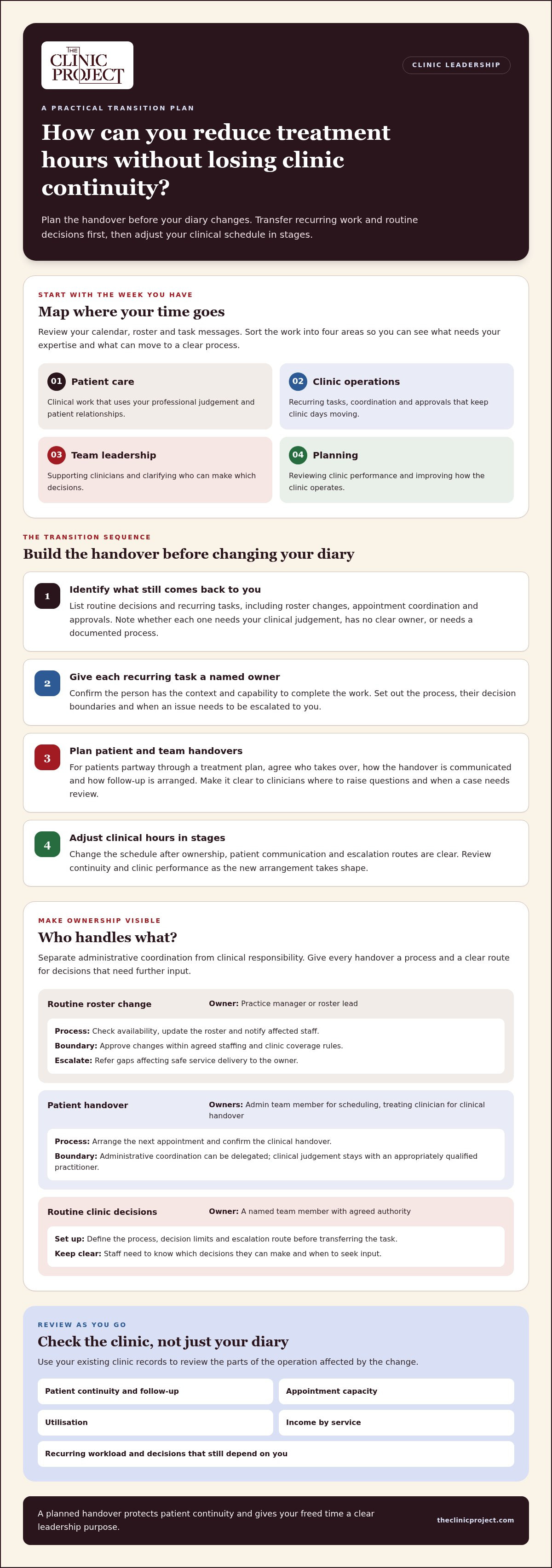
- Where does your week actually go? Tally one normal week across four buckets: treating, operations, team and planning. Most owners find operations and team questions are scattered through every clinical day in five-minute fragments.
- What still needs your yes? For two weeks, write down every question that reaches you. Then sort each one: does it need your clinical judgement, a documented process, or a person with authority to decide? Only the first group genuinely needs you.
- Does your team have room? This is the check owners skip, and it’s the one that decides whether patients stay.
Here’s how the third check plays out. Say you treat four days a week and want to drop to two. At ten appointments a day, that’s twenty appointments a week that need a new home. If your two associates are already booked at 90%, those twenty appointments won’t fit, patients will drift, and revenue drops with them. Your first move there is a hire or a waitlist plan. If your associates are sitting at 70%, there’s room, and your job is to transfer patients well.
I also look at billings per practitioner. The benchmark I’ve used since 2023 is $300k a year. An associate well under that usually has capacity to absorb your patients. One sitting above it probably doesn’t.
What should you hand over first to get off the tools?
Start with the decisions that interrupt you most often and carry the least clinical risk. For most clinics, that’s three things:
- Roster swaps and cover
- Appointment moves and rebooking
- The admin side of patient handovers
Clinical judgement stays with the treating clinician. What you’re handing over is the logistics and the authority to act on them.
| Task | Owner | They decide | They escalate |
|---|---|---|---|
| Roster swaps and cover | Practice manager | Any swap that keeps minimum cover on the floor | A gap that leaves a session uncovered |
| Appointment moves and rebooking | Front desk | Moves within the treating clinician’s diary | A patient asking to change clinician |
| Patient handover when you step back | Treating clinician (clinical), admin (booking) | The clinical plan and next appointment | Complex cases, to your clinical lead |
| Fee and account questions | Practice manager | Payment arrangements within your written policy | Refunds or write-offs above your set limit |
The column that matters most is “They decide”. A decision limit is a written line someone can act within without checking with you. “Approve any swap that keeps two physios on the floor” is a decision limit. “Use your judgement” is how the question ends up back on your phone at 7pm.
In my clinics, the practice manager owns operations and the clinical lead owns clinical standards and mentoring. My standing commitment is a monthly two-hour leadership meeting. That structure is why the clinic keeps running when I’m away.
How do you get off the tools in stages?
- Set your baseline. Record your current roster, team utilisation, billings per practitioner and rebooking rate. You need these numbers to know whether the change worked.
- Hand over ownership. Assign each recurring decision from your two-week list to one person, write the decision limit, and tell the team who now owns it.
- Drop one session. Brief the patients affected, book their next appointment with the new clinician before they leave, and block the freed time in your diary for leadership work.
- Review after four weeks. Did those patients rebook with their new clinician? Did billings hold? Which questions still reached you? Anything that still lands on your desk points to a missing owner or a missing limit, so fix that before you drop the next session.
Then repeat. Most owners I work with need 6 to 18 months for changes like these to fully stabilise, because the team needs time to trust their own authority.
Decide what the freed hours are for before you lose them. Put your leadership block where your energy is best, and protect it like a patient booking. Designing your week around how you actually work, rather than around the diary you inherited, is the core of what I call the CEO Workflow. It’s the difference between stepping back and simply working different hours.
What changes when the handover holds?
Treating less is a choice about where your hours go. Your clinical judgement stays in the building through the people you hire, the standards you set and the clinical lead who holds them.
The other change is value. A clinic that runs without you is a clinic someone would buy. I’ve grown two clinic brands while taking three to four months off each year since 2022, and it came from repeating this exact sequence: owner, limit, handover, review.
If you want to see where your clinic stands before you start, take The Clinic Audit. It’s a 10-minute quiz that shows which parts of your clinic still depend on you. If you’d rather talk it through, book an Impact Call with me.
Frequently Asked Questions
Can I run an allied health clinic without treating patients?
Yes. Once operations, team decisions and clinical standards each have a clear owner, your role moves to leading the clinic, while your clinicians deliver care and your clinical lead holds the standard.
How do I reduce my clinical hours without losing income?
Drop one session at a time and check your numbers four weeks after each change: rebooking rate for the patients you handed over, billings per practitioner and team utilisation. If rebooking falls or your team is already above 85% utilisation, fix capacity before you drop another session.
What should I delegate first?
Roster swaps, cover and appointment moves. They interrupt you most often, carry the least clinical risk, and are easy to write a clear decision limit for.
How long does it take to get off the tools?
Plan for 6 to 18 months for the changes to fully stabilise. Early clinics move faster because you’re building structure from scratch. Established clinics take longer because the team has to unlearn years of checking with you first.

Article by
Winnie Wu
Physiotherapist Winnie Wu builds allied health clinics that are highly profitable and run without their owner. She has founded four health brands. Her two Sydney clinics, Movement Laboratory and the award-winning Papaya Clinic, let her take three to four months off every year. Through The Clinic Project she works directly with women clinic owners on profit, systems and leadership, and her Set to Scale clients average a 32% profit margin, more than double the industry average. Every framework she teaches runs in her own clinics first.