

Allied Health Practice Growth Program: How to Find the Right Fit

What if sustainable growth starts with doing less, but fixing the right constraint? If day-to-day clinic operations leave little room for strategy, choosing an allied health practice growth program based on ambition alone may add activity without addressing what is slowing progress.
It’s understandable to want clearer systems and more consistent growth while questioning whether general business advice fits the realities of clinical service delivery. The right support should match your clinic’s current needs, whether you’re strengthening foundational systems, resolving a specific bottleneck or making space for focused planning and peer collaboration.
This article will help you identify your most important growth constraint, compare formats of strategic support and choose an approach that fits your stage and priorities. We’ll look at what to assess before committing, how support formats differ and how The Clinic Project’s offerings, including Set to Scale, Impact Mastermind, CEO Weekend, Hybrid Fast Track and Clinic Owners Retreat, are positioned for allied health clinic owners across Australia.
Key Takeaways
- Separate the symptoms of stalled growth from the underlying constraint before choosing support.
- Check your priorities, capacity to implement changes and appetite for strategic work.
- Match an allied health practice growth program to the support you need, such as stronger systems, focused guidance, peer learning or strategic planning.
- Ask how the approach is tailored, how implementation is supported and how progress will be reviewed.
- Choose a small set of measures that reflect your priority, then compare the support formats that fit your situation.
What is an allied health practice growth program, and when does a clinic need one?
An allied health practice growth program is structured strategic support that helps a clinic improve its business operations and plan for sustainable growth. It focuses on how the practice is run, not on delivering patient care. Allied health includes a broad range of professions, as outlined in the Allied health professionals overview, so useful business support needs to recognise the realities of clinical service delivery.
A growth program isn’t clinical supervision, practice management software or general motivation. Supervision supports clinical practice, software helps manage information or workflows, and motivation may inspire action without establishing priorities, systems or follow-through. Strategic support connects business decisions with practical implementation.
That distinction matters when you’re balancing client care with the responsibility of leading a business. The clinic may stay busy while work on systems, team coordination or financial oversight gets pushed aside. This isn’t necessarily a lack of commitment. It may indicate that the way the practice operates needs attention.
Signs your clinic may need structured growth support
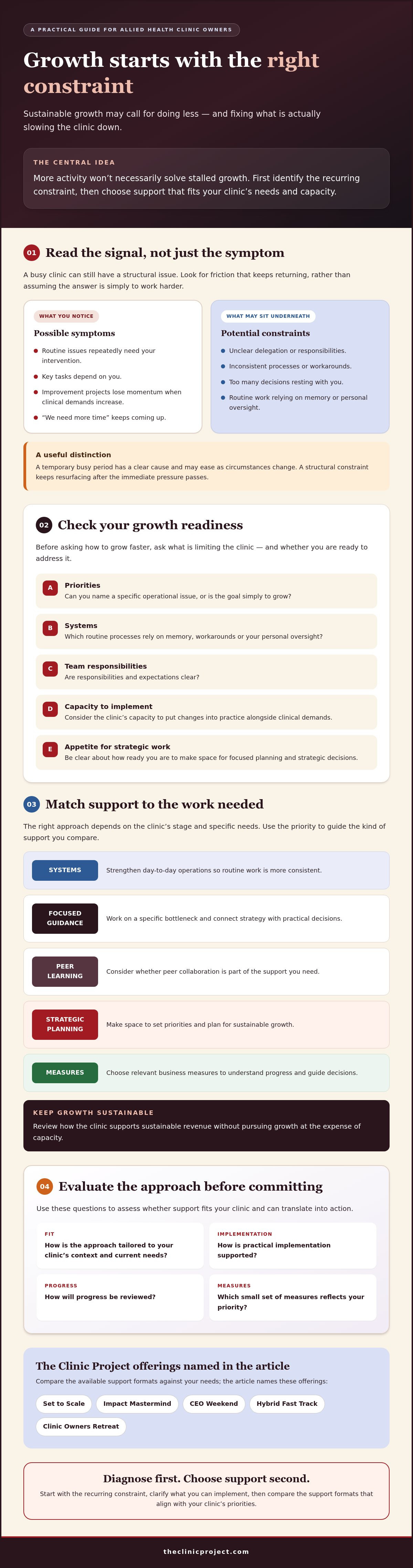
Look for recurring problems that persist despite your extra effort. You might repeatedly step in to resolve routine issues, find that key tasks depend on you, or see improvement projects lose momentum when clinical demands increase. These patterns suggest the issue may be in the operating structure, rather than your willingness to work harder.
Unclear priorities can make growth reactive. One week you’re addressing a staffing pressure, the next you’re chasing a new opportunity, without resolving the underlying bottleneck. A temporary busy period usually has a clear cause and eases as circumstances change. A structural constraint keeps resurfacing after the immediate pressure passes.
What a practice growth program should help you work on
An allied health practice growth program should help you identify the constraint that matters most, then connect strategy to decisions and implementation. Depending on your clinic’s needs, that work may involve:
- Strengthening systems and day-to-day operations so routine work is more consistent.
- Choosing relevant business measures to understand progress and guide decisions.
- Reviewing how the clinic supports sustainable revenue, rather than pursuing growth without considering capacity.
The right focus depends on your clinic’s stage and specific needs. A practice building reliable foundations may need different support from one preparing for strategic expansion. Start by asking what keeps getting in the way, what information would help you understand it, and what you’re ready to put into practice. Those answers give you a clearer basis for deciding whether structured support is the right next step.
Assess your allied health clinic’s growth readiness before choosing a program
A useful starting point isn’t “How can we grow faster?” It’s “What’s currently limiting the clinic, and are we ready to address it?” You don’t need every answer before seeking support. But the clearer you are about your priorities and capacity, the easier it is to assess whether an allied health practice growth program suits your needs now.
A clear starting point improves program fit because it directs support towards the clinic’s actual constraint, rather than a broad ambition. Allied health clinics differ in their services, teams and operating pressures. The Association of Schools Advancing Health Professions focuses on allied health education and issues affecting the field, reinforcing why business support should be relevant to your clinic’s context rather than assumed to be one-size-fits-all.
Identify the constraint behind your growth goals
Before looking for a solution, separate symptoms from root causes. “We need more time” may be a symptom. The underlying issue could be unclear delegation, inconsistent processes or too many decisions resting with you. Review the areas below and note where the same friction keeps returning.
- 1. Priorities: Can you name a specific operational issue, or is the goal simply to grow?
- 2. Systems: Which routine processes rely on memory, workarounds or your personal oversight?
- 3. Team performance: Are responsibilities and expectations clear, and where does work get stuck?
- 4. Business measures: Do you review information that helps you understand performance and make decisions?
- 5. Leadership capacity: Which recurring tasks or decisions depend too heavily on you?
A broad wish to grow can be a worthwhile ambition, but it doesn’t identify what needs to change. A specific pattern, such as routine approvals repeatedly waiting for the owner, gives you a practical starting point to investigate.
Check whether your clinic can act on strategic support
Support is more useful when there’s room to apply it. Consider whether you can protect time for planning and implementation, even if you begin with one focused improvement. Think about who needs to contribute, too. A change to a shared process may require input from the people who use it day to day.
- 6. Capacity: Can you make space to work on the priority, not just discuss it?
- 7. Commitment: Are you willing to test changes, review what’s working and adjust?
- 8. Alignment: Who needs to understand or support the change for it to stick?
If capacity is limited or the priority is still unclear, it may be sensible to pause before committing to a larger program. Choose one realistic focus rather than trying to fix every part of the clinic at once. To clarify what kind of support may fit, explore allied health growth support and compare the available approaches.
Compare allied health practice growth program formats and match support to your needs
Support formats aren’t interchangeable. The best fit depends on whether your main need is to strengthen operations, work through a bottleneck, learn alongside peers or make space for focused planning. Use the comparison below to narrow your options, then check what each program currently includes and how it relates to your clinic.
| Primary need | Support format | May suit you if… |
|---|---|---|
| Build stronger operational foundations | Structured systems and operations support | Recurring processes, business measures or sustainable revenue need more attention. |
| Address a defined operational bottleneck | Focused consulting and coaching | You can name a specific issue and want targeted strategic input. |
| Gain perspective through peer learning | Strategic mentoring and peer collaboration | You’re an established owner who values learning with other clinic leaders. |
| Step back and plan strategically | Intensive planning or owner retreat | You need dedicated space for a business roadmap, workshops or high-level planning. |
Workforce considerations can also shape a clinic’s priorities. For example, the allied health workforce development work of NC AHEC addresses workforce development and distribution. This is a reminder to consider team capacity alongside systems and growth goals, while assessing your own clinic’s circumstances.
When foundational systems or focused guidance may be the priority
Set to Scale focuses on systems, operations, business measures and sustainable revenue. It may be relevant if recurring operational demands are limiting your ability to lead the clinic. Hybrid Fast Track focuses on consulting and coaching for operational bottlenecks, making it a potential match when you have a specific issue to address. Before deciding, verify the current delivery format, inclusions and suitability for your needs.
Neither format promises a particular result. Ask how the guidance relates to clinical service delivery and how you’ll translate recommendations into decisions and day-to-day practice.
When peer collaboration or intensive planning may suit
Impact Mastermind centres on strategic mentoring and peer collaboration for established owners. CEO Weekend provides an intensive setting for strategic planning and a business roadmap. Clinic Owners Retreat offers space for workshops, networking and high-level planning. Each creates a different structure for strategic work. Consider whether you need peer exchange or a more concentrated planning environment.
If you’re concerned that a program may be too general, ask how it accounts for your clinic’s stage, priorities and operating context. Clarify what implementation support and progress reviews involve, and confirm current details directly before committing. This gives you a grounded basis for comparing an allied health practice growth program with the work your clinic actually needs.
Evaluate a growth program’s approach, implementation and measures before committing
A clear program description is only the starting point. Before choosing an allied health practice growth program, check how its strategic guidance will connect with your clinic’s decisions and day-to-day work. A good fit should make the next steps easier to understand, rather than leave you with ideas and no plan to apply them.
Questions to ask before joining a clinic growth program
Use these questions to assess whether the approach suits your priorities and capacity:
- How are clinic priorities identified? Ask how the program learns about your business and adapts its guidance to your clinic’s services, stage and operating context.
- What participation is expected? Clarify what you’ll need to do between scheduled sessions, including preparation, decision-making and implementation.
- How is progress reviewed? Ask how you’ll revisit priorities, discuss barriers and decide whether to adjust the plan.
- What are the current details? Confirm the time commitment, delivery format and inclusions directly, as these can vary between programs.
Be realistic about your capacity. If clinical responsibilities already fill most of your week, understand how much time you’ll need to set aside to turn recommendations into action. The aim isn’t to find support that removes every demand. It’s to choose an approach whose expectations are realistic for you and your clinic.
Make the work measurable without overcomplicating it
Start with a baseline related to the constraint you want to address. If routine decisions keep landing with you, track how often you need to step in and whether tasks are completed without your involvement. If the concern is financial, choose relevant revenue or profitability measures with appropriate context. These figures depend on each clinic’s services, costs and circumstances, so don’t treat any single measure as a universal benchmark.
Pair business metrics with observable changes in how the clinic operates. A measure might show whether a process is being followed. A practical observation might reveal whether fewer tasks are being escalated to the owner. Keep the set small enough to review consistently. At agreed review points, decide what to continue, adjust or stop based on what the information shows.
Check program fit by looking for clear priorities, relevant guidance, realistic participation, practical implementation and measures you can review. This checklist helps you compare what’s promised with the working relationship and structure you’ll actually need.
To explore strategic support for your clinic, review The Clinic Project’s growth support and confirm the current program details that matter to your decision.
Explore The Clinic Project’s allied health practice growth programs
The Clinic Project’s options offer different forms of strategic support. Start with the constraint you identified rather than choosing by name alone. The aim is to find a format that aligns with your clinic’s current priority, stage and capacity to put changes into practice. No program can guarantee a particular result, and fit depends on your circumstances.
Match your clinic’s current priority to a support pathway
- Systems and operational foundations: Set to Scale focuses on systems, operations, business measures and sustainable revenue. Consider whether this matches the foundational work your clinic needs.
- Strategic mentoring and peer learning: Impact Mastermind centres on strategic expansion and peer collaboration for established owners. It may be relevant if you want to work through growth decisions alongside other clinic owners.
- A defined operational bottleneck: Hybrid Fast Track focuses on resolving bottlenecks through a focused support format. It may suit a clearly identified operational issue that needs attention.
- Focused strategic planning: CEO Weekend centres on intensive planning and developing a business roadmap. Clinic Owners Retreat offers space for workshops, networking and high-level planning.
These are distinct pathways, not interchangeable packages. If recurring operational friction is taking up your attention, compare that need with Set to Scale’s systems focus or Hybrid Fast Track’s bottleneck focus. If your priority is stepping back to map your direction, consider whether a planning or retreat format better matches the work you want to do.
Before deciding, confirm current program availability, delivery format, time commitment, inclusions and suitability directly. Ask how the support relates to your clinic’s specific constraint and what participation and implementation involve. Details can change, so don’t rely on assumptions based on a program name or description alone.
Take a considered next step with The Clinic Project
Founded by allied health business strategist Winnie Wu, The Clinic Project supports clinics across Australia. Before exploring an allied health practice growth program, clarify three points: your clinic’s stage, the main constraint you want to address and the direction you want the business to take. Sharing those priorities can help you assess which support format is relevant, without treating any pathway as a guaranteed solution.
To explore your options, review growth support for your allied health clinic. Check the current program details and consider how each format fits the work your clinic is prepared to undertake.
Choose support that fits your clinic’s next step
The right allied health practice growth program addresses your clinic’s actual constraint, not simply its ambition. First clarify what is holding progress back, then consider whether you have the capacity to implement changes and how you’ll recognise progress. A focused priority gives you a stronger basis for comparing support than trying to solve every operational challenge at once.
The Clinic Project, founded and operated by allied health business strategist Winnie Wu, supports allied health clinics across Australia through distinct formats. These include structured programs, a mastermind, an intensive weekend and a retreat. They’re different ways to approach strategic work, so check current details and discuss fit before deciding.
To discuss which approach may suit your clinic’s stage and priorities, explore growth support for your allied health clinic. Start with the constraint you can see, then take a considered next step.
Frequently Asked Questions
What is an allied health practice growth program?
An allied health practice growth program is structured strategic support for improving a clinic’s business operations and planning its growth. It focuses on how the practice is run, not clinical care, and isn’t practice management software or general motivation. Depending on the clinic’s needs, support may address systems, business measures, leadership or operational priorities. The right focus should reflect your clinic’s circumstances, rather than follow a fixed formula for every practice.
How do I know if my allied health clinic is ready for a growth program?
Your clinic may be ready if you can identify a priority, protect time to work on it and involve the people whose decisions or work may be affected. You should also have a way to review whether changes are helping. Readiness doesn’t mean every system is already in order. A clear issue, such as recurring delays in routine decisions, can be enough to begin a useful discussion about support and implementation.
What should an allied health business growth program include?
A suitable program may include strategic guidance relevant to your clinic, work on operational systems, business measures linked to your priorities and support to put decisions into practice. It should also provide a way to review progress and adjust the approach. The emphasis will vary: a clinic addressing inconsistent processes may need different guidance from one planning strategic expansion. Treat these elements as points to discuss, not a mandatory checklist for every practice.
How do I choose the right growth program for my allied health practice?
Start by naming the main constraint you want to address, such as owner-dependent decisions or unclear processes. Then compare formats, including structured programs, peer-based support and intensive planning, against your available time and preferred way of working. Ask how the guidance accounts for allied health service delivery and how implementation is supported. Confirm current delivery details, suitability and inclusions directly with the provider before making a decision.
Can an allied health practice growth program help me spend less time in day-to-day operations?
Structured support may help you examine which tasks rely on you, where responsibilities could be clearer and whether systems support consistent day-to-day work. For example, you might review how routine decisions are handled or how recurring processes are documented. Any change will depend on your clinic’s circumstances and your involvement in implementing it. A program can guide this work, but it can’t guarantee reduced hours or remove the need for owner participation.
What is the difference between a growth program, a mastermind and a business intensive?
A structured growth program generally supports business improvement through a defined pathway, such as strengthening systems and operations. A mastermind centres on strategic discussion and peer collaboration, while a business intensive concentrates planning into a focused period. These are broad distinctions, not standard definitions. Providers may use the terms differently, so check the current format, participation expectations, duration and inclusions before deciding which option aligns with your priorities.
How can I measure whether a clinic growth program is working?
Agree on a baseline before changes begin, then choose a small set of measures tied to your priority. If the issue is owner-dependent decisions, track how often tasks are escalated to you and whether responsibilities are completed as intended. Pair operational indicators with relevant business measures, such as revenue or profitability where appropriate. Review them at agreed points and decide what to continue, adjust or stop, without assuming a predetermined result.