


A clinic owner retreat in Australia has no single ideal length. The right fit depends on whether you need genuine rest, space to think or structured time to work through decisions you’ve been carrying back to the clinic. A longer stay isn’t automatically more useful: the retreat should give you room to reset and leave with clear next steps.
If your clinic is busy but still relies on you to approve every roster change, fee adjustment or patient handover, it’s worth considering how time away could help. Program length, group format, facilitator support and professional focus all shape the experience, as does the follow-up once you’re back in the day-to-day. Look for a retreat designed for allied health clinic owners, with practical clarity to take home, not just a notebook full of ideas.
Key Takeaways
- Choose group size and facilitator support based on how much personal attention and peer discussion you need to make progress.
- Compare program length and post-retreat follow-up with the decisions you need to make once you’re back at the clinic.
- Check that the retreat’s professional focus matches your role, whether you need space to reset or structured time for business decisions.
- Use the 2026 retreat options to narrow your choices, then identify the next step that best fits your clinic’s current needs.
1. Group size and facilitator support
Group size affects how much airtime you get, but headcount alone tells you little. Find out how many clinic owners attend and whether the same group stays together. Peer discussion needs a different structure from an individual wellness experience. If you need to decide on a fee schedule, protected working time matters more than a packed timetable.
Find out how sessions are facilitated, not just what the retreat includes. Will you work through a live clinic question, such as who handles roster changes when your practice manager is away? A useful facilitator makes room for peer insight while keeping the discussion connected to each owner’s next decision. The goal is to leave with an action, not only a new contact.
Check what support is available between group sessions. If a conversation raises a difficult team handover, can you return to it with the facilitator? Find out how they keep discussions focused and help turn ideas into practical next steps. That support matters when you’re balancing operational decisions with clinical work.
Match the group format to your goal. If you need quiet to reflect, a large-group timetable may leave little space for individual thinking. If you want to test a new service model, structured peer feedback can help you examine the patient journey, staffing impact and follow-up. A therapy or wellness focus may support wellbeing, while business facilitation should address clinic operations.
The setting shapes the experience. A restorative environment may help you pause, but scenery alone won’t resolve the 7pm question about roster approval. Ask how the program balances rest, healing, discussion and focused work. That balance should reflect the decisions you need to make.
Before booking, write down one decision you want to move forward. Ask who facilitates the work, how group discussion is managed and what you’ll take back to the clinic. Clear answers help you judge whether the group format, facilitator support and setting suit your purpose.
For context, as of September 22, 2026, the median employee-size band for Australian wellness retreat companies was 1-10 employees. That sector-wide measure may help frame questions about facilitator capacity, but it does not establish how much individual attention any particular group will receive; ask directly about support.
2. Program duration and post-retreat follow-up
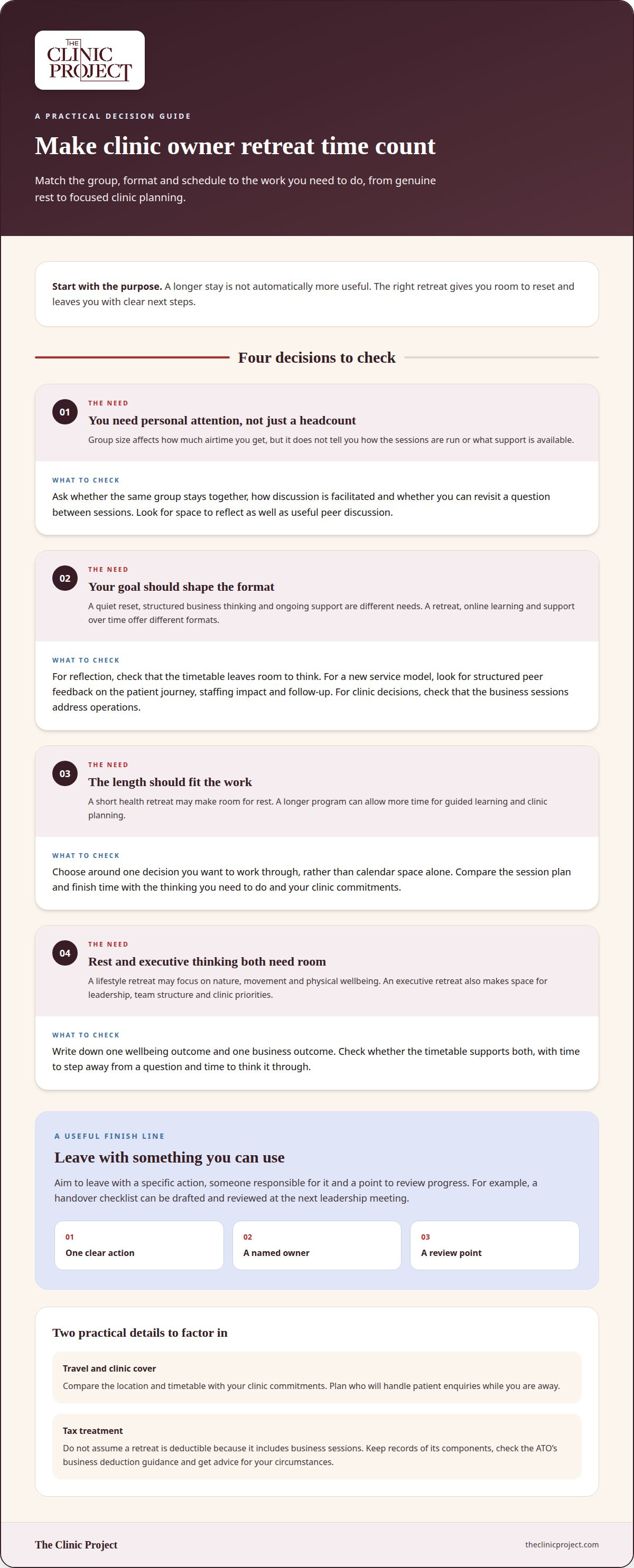
Match the retreat duration to the work you need to do, rather than choosing by calendar space alone. A short health retreat may make room for rest, while a longer program can allow more time for guided learning and clinic planning. Before booking, identify one decision to work on, such as changing your Tuesday roster or delegating patient follow-up.
Compare in-person retreats, online programs and business coaching by their format and focus. A retreat gives you dedicated time away with other owners; online learning can fit around clinic hours, while coaching supports decisions over time. Choose the format that suits your next task, whether you need to reset your thinking or work through a fee-schedule change.
For tax deductibility, I wouldn’t assume a retreat is deductible just because it includes business sessions. The ATO’s guidance on business deductions explains the relevant principles; keep records of the retreat’s components and get advice for your circumstances.
Retreats take place in different settings, from city venues to regional locations. Weigh the travel and timetable against your clinic commitments, then plan who will handle patient enquiries while you’re away.
Activities may include guided reflection, peer learning and business planning, alongside meditation or other wellbeing experiences. Aim to leave with a specific action, an owner and a review point. For example, ask your practice manager to draft a handover checklist, then review it together at your next leadership meeting.
Dates, duration and booking deadlines depend on each retreat’s published schedule. Compare the start and finish times, session plan and follow-up arrangements before organising clinic cover. If you want to think through how time away fits your priorities, discuss your retreat priorities with me.
3. Retreats for professionals and executives
A clinic owner’s retreat should make room for recovery and executive thinking. Monday might start with patients and turn to payroll by lunchtime. Time away should give you space to examine decisions only you can make. Relaxation can help you reset; protected planning time can clarify your leadership priorities.
Professional focus matters. A lifestyle retreat may centre on nature, movement and physical wellbeing. An executive retreat should also address leadership, team structure and clinic priorities. Before choosing, name one decision you need to make, such as whether your practice manager can approve routine roster changes.
Use a practical test when reviewing retreat schedules: can each block support recovery or help you make a business decision? A morning walk may clear mental space; a working session can help define a delegation boundary. Time to consider an operational question should sit alongside time away from it.
At Movement Laboratory and Papaya Clinic, I plan around the owner’s energy and fixed commitments. I’ve grown two clinic brands while taking three months off each year since 2022. That experience shapes how I assess a retreat. Can you return with a decision and a named owner for the next action? Can your team follow the process without another approval?
Set your criteria before booking. Write down one wellbeing outcome and one business outcome. For example, use the retreat to decide how weekly roster checks can move to your practice manager. Compare the timetable and professional focus against those outcomes. Travel should support the reset, not consume the time you need for reflection. A retreat earns its place when you return with a clearer priority, a delegated decision or a process your team can run.
4. Clinic owner retreats available in Australia in 2026?
For 2026, compare retreats by their audience, format and published schedule. A retreat designed for allied health clinic owners should address decisions like delegating roster approvals or reviewing practitioner capacity. A general wellbeing retreat may centre on rest and reflection instead. Both can be worthwhile, but they solve different problems.
Build a shortlist around your current need. If you’re carrying every operational decision, look for a retreat with facilitated business discussion and time to work through a real clinic issue. If you need recovery first, prioritise a quieter setting and a timetable with room to rest. Name your desired outcome before comparing event descriptions.
Check each 2026 listing for the essentials: intended participants, location, start and finish dates, session structure, facilitator involvement and follow-up. Then compare those details with your clinic calendar. For example, identify who can manage patient enquiries while you’re away, and brief that person before confirming travel. Published event details help you plan cover without leaving your team guessing.
Use a simple comparison note for each option: what you’ll work on, what support is included and what happens after the final session. A retreat with business planning may suit an owner who needs to reset team responsibilities; a wellbeing-focused experience may better suit someone seeking time away from clinic pressures. Choose the format for the outcome, not the scenery alone.
If you’re still weighing retreat priorities against your clinic’s needs, Book an Impact Call with Winnie. Before that conversation, write down one decision you want to make and one task you need covered while away. That turns a broad search for 2026 options into a practical choice about time, support and follow-through.
The Clinic Project: Set to Scale
The Clinic Project helps allied health clinic owners turn retreat reflection into practical business decisions. If you’ve identified a bottleneck and need structured support to address it, Set to Scale is designed for clinic owners in the Messy Middle. The Clinic Owners Retreat brings rest, play, mastermind and focused work together.
Choose based on what you need next. If time away would help you reflect and reset, consider the retreat. If you’re ready to work through clinic systems and leadership priorities, explore Set to Scale. For a larger clinic leadership team, Impact Mastermind may be a better fit.
Before deciding, write down the clinic decision you want to move forward and the support that would help you act on it. Contact The Clinic Project to discuss the next step that fits your priorities.
Make your next decision deliberately
Time away matters most when it changes what happens on an ordinary clinic day. Before booking, decide what you want to make room for: fewer decisions in your inbox, a clearer leadership role or time to think beyond next week’s roster. That intention gives your retreat a practical purpose.
Choosing a clinic owner retreat in Australia is one decision; protecting the change you want afterwards is another. Pick one boundary to carry home, such as leaving routine appointment changes with your practice manager. A small, clear shift can create room for more considered leadership without requiring you to redesign everything at once.
If you’re ready to work out which kind of support fits your current priorities, I invite you to Book an Impact Call with Winnie. Bring the decision you’ve been postponing, and we can discuss a useful next step. You can make space for a clinic that supports the life you want to lead.
Frequently Asked Questions
How long does it take?
The retreat duration depends on its published schedule; applying the ideas happens back at your clinic. Before attending, block time in your calendar to review your notes and assign each action to someone. If you plan to delegate fee-schedule updates, for example, set a follow-up meeting with your practice manager before you leave.
What is a clinic owner retreat in Australia?
A clinic owner retreat in Australia gives allied health business owners dedicated time away to reflect and work on their clinic’s direction. The Clinic Owners Retreat combines strategic workshops, executive networking and planning. You could use that time to map a leadership decision, such as who owns the weekly review of practitioner availability.
Who are the retreats designed for, and what professions do they cover?
These retreats are designed for allied health clinic leaders, including owners in physiotherapy, osteopathy, psychology, speech therapy, massage therapy, chiropractic and naturopathy. Multidisciplinary clinic owners can bring questions that span professional teams, such as how to clarify referral handovers. Before enrolling, consider whether you want peer discussion with owners facing similar operational decisions.
What should clinic owners check before booking a retreat?
Check that the retreat’s focus, schedule and participant profile match the work you want to do. Then plan clinic cover: name who will handle urgent roster questions, patient enquiries and routine approvals while you’re away. Ask your practice manager to record those responsibilities in a handover note, so the team knows what to resolve independently and what genuinely needs escalation.

Article by
Winnie Wu
Physiotherapist Winnie Wu builds allied health clinics that are highly profitable and run without their owner. She has founded four health brands. Her two Sydney clinics, Movement Laboratory and the award-winning Papaya Clinic, let her take three to four months off every year. Through The Clinic Project she works directly with women clinic owners on profit, systems and leadership, and her Set to Scale clients average a 32% profit margin, more than double the industry average. Every framework she teaches runs in her own clinics first.