

Hybrid Fast Track: What Can an Allied Health Accelerator Program Help You Build?
Your clinic is busy, but roster changes, fee decisions and patient handovers still need your approval. You’re carrying the operational load while trying to make space for strategic work. An allied health accelerator program can provide a structured way to develop a business idea.
For a clinic owner in Australia, the key question is whether the learning fits around clinical work and supports a real priority. Before choosing a program, understand its time commitment, curriculum and specialist input.
This article explains how accelerator schedules and cohort learning work, what course content may cover, and how to assess whether the structure suits your clinic. Use these considerations to decide which next step fits your team, capacity and planned service.
Key Takeaways
- Compare accelerator timelines with the work you need to complete and the time your clinic can set aside.
- Assess whether cohort support covers the practical areas your offer needs, from business development to customer acquisition.
- Map the curriculum against your clinic’s priorities so each learning stage leads to a clear next action.
- For a focused path to creating and selling a hybrid program, Hybrid Fast Track is a self-paced course designed to take four weeks.
Healthcare accelerator benefits and specialist support
An allied health accelerator can connect startups with clinical, regulatory and commercial expertise. Compared with a general startup accelerator, its focus can centre on care delivery, patient needs and health-sector adoption. The U.S. Bureau of Labor Statistics projects approximately 1.9 million healthcare job openings annually through 2034.
Accelerators are run by different organisations and networks, so local access depends on the organiser. In Australia, consider cohorts connected with universities, health services or regional innovation networks. UT Health San Antonio provides a point of comparison for university commercialisation support. Compare how each model connects research, clinical input and practical application.
Specialist support may include clinician feedback, regulatory expertise, business development and customer acquisition guidance. For instance, a clinic developing a patient education service could test its proposed pathway with clinicians, then refine the offer for its intended audience. Mentorship is most useful when it helps resolve a specific decision.
Technical support should connect technology choices to everyday clinic workflows. Map the steps from patient enquiry to follow-up, then identify where staff training is needed. A shared referral checklist, for example, can show how a new digital tool fits existing handovers and patient communication.
Outcomes depend on what an accelerator measures. Compare milestones such as completed pilots, customer adoption, research partnerships or progress towards launch. A reported success rate is useful only when its definition, timeframe and the startups included are clear.
Before applying, review the time commitment, intellectual property terms, confidentiality requirements and any equity arrangements. Consider how sessions fit around patient care and team responsibilities. These details affect the practical cost of participation, even when a program offers strong specialist access.
Support after the cohort ends matters too. Consider how implementation, staff development and technology maintenance will continue. A workable clinic handover plan identifies who owns the process, how patient feedback is collected and when the team reviews the service.
Startups in an accelerator may connect directly with clinicians, regulatory experts and venture capital networks. These connections bring clinical, regulatory and investment perspectives into the same support environment.
Accelerator duration and schedule
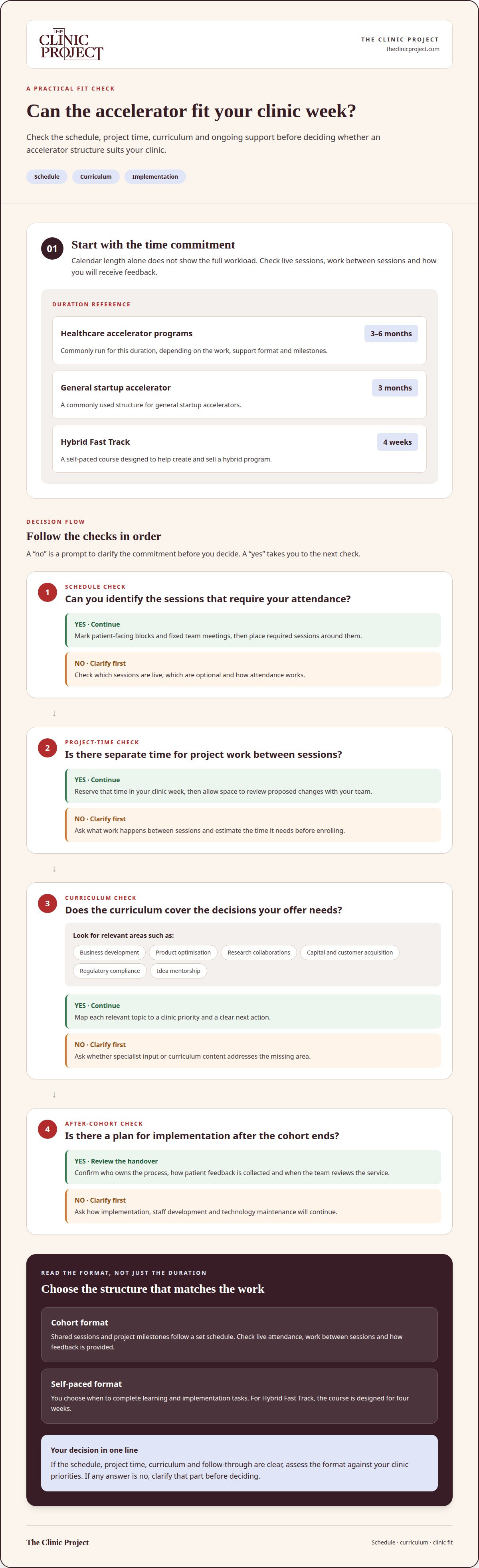
Healthcare accelerator programs commonly run for 3 to 6 months. A general startup accelerator commonly follows a three-month structure. Duration reflects the work involved, support format and milestones set by organisers. For a clinic owner, the timetable needs to fit around patient appointments, team supervision and business administration.
A cohort schedule sets shared sessions and project milestones across the program. A self-paced format lets you choose when to complete learning and implementation tasks. Check whether sessions are live, what work happens between them and how participants receive feedback. These details reveal the practical commitment more clearly than calendar length alone.
Map the schedule against your actual clinic week before enrolling:
- Mark patient-facing blocks and fixed team meetings.
- Identify sessions that require your attendance.
- Reserve separate time to complete project work.
- Allow space to review changes with the team before implementation.
Credit hours belong to some formal education pathways, rather than every business accelerator. Applicants with an associate degree must have a minimum of 60 total credit hours. Keep academic entry requirements separate from the accelerator workload, then identify which commitments involve study and which involve developing your clinic project.
For example, if your appointments run back-to-back on Mondays, you might reserve a quieter Wednesday morning for project work. A regular roster review can show whether that block stays protected when leave or referral demand changes. Your team also needs clear ownership of operational decisions during your learning time.
If you want to align your clinic’s priorities with a workable schedule, discuss your clinic’s next steps.
Cohort-based accelerator curriculum
A cohort curriculum gives allied health founders a shared structure for developing an idea and preparing for launch. Its value comes from applying each lesson to a real clinic challenge, such as improving a referral pathway or designing a group service. Let your mission guide the work, while patient needs and operational capacity shape decisions.
Curriculum areas may include business development, product optimisation, research collaborations, capital and customer acquisition, regulatory compliance, and idea mentorship. A cohort lets participants compare approaches with peers tackling different health-care challenges. Test your assumptions in discussions, then bring relevant feedback to your clinic team for review.
A practical way to work through the curriculum is to:
- Define the patient problem and the outcome your offer supports.
- Map the service pathway, including intake, delivery and follow-up.
- Identify the buyer and the steps needed for customer acquisition.
- Set a launch milestone and record what evidence will inform your next decision.
For example, a speech pathology clinic developing a parent education group can map the referral process before refining the session content. A physiotherapy clinic testing a digital follow-up resource can review patient communication and staff responsibilities. These examples turn product optimisation into specific development work rather than a broad discussion about innovation.
Bring one defined question to each cohort meeting, such as whether a proposed format fits the team’s current roster. Ask a clinician to review the care pathway, then document operational changes needed before launch. Research collaborations and specialist mentorship can help clarify the next development step. Record decisions and outcomes in a shared document so cohort discussions lead to useful input for your clinic.
Curriculum and course layout
A useful course layout turns curriculum topics into decisions you can apply in an allied health clinic. Start with one clinical service or patient pathway, such as the handover from an initial physiotherapy assessment to follow-up care. Connect each lesson to a practical output your team can review.
For example, a product development curriculum should help you define the service, its intended patient and its delivery process. A clinic designing a group program could map enrolment, session preparation, practitioner responsibilities and follow-up communication. Involving the clinicians who will deliver the service can reveal operational gaps before launch.
Use this sequence to make course material actionable:
- Choose one patient or clinic problem to address.
- Map the current clinical pathway, from enquiry to follow-up.
- Identify where health systems, team roles or communication affect delivery.
- Build a small test and decide what feedback will guide the next step.
Each stage should produce a working document, such as a service outline, referral script or team handover checklist. A speech pathology clinic could draft parent information before changing its intake process. A multidisciplinary practice could map which practitioner owns each step as a patient moves between services.
Course structure matters as much as topic coverage. Lessons, templates and review points should connect, helping you move from a clinical idea to a workable service pathway while keeping patient experience in view. Schedule regular implementation time alongside your clinic’s existing planning meeting, then bring a draft or decision to the team for feedback.
When the curriculum needs to connect with your clinic’s broader strategy, Book an Impact Call with Winnie to discuss the next practical step.
The Clinic Project: Set to Scale
The Clinic Project helps allied health clinic owners build more structured, sustainable businesses through support suited to their stage and priorities. Set to Scale helps owners in the Messy Middle strengthen systems for profit, people and day-to-day decisions.
If your priority is creating and selling a hybrid program, Hybrid Fast Track is a self-paced course focused on that project. It offers a structured way to develop your offer alongside clinical and operational commitments. The right next step depends on whether you need clinic-wide structure, strategic input from peers or support to build a hybrid service.
Explore The Clinic Project’s programs and choose the next step that fits your clinic’s current priorities.
Choose the next step that fits your clinic
Choosing an allied health accelerator program is a business decision. The work should fit your clinic’s priorities, your team’s capacity and the service you want to build. Before committing, write down the change you want to make, who needs to be involved and what progress would look like. This gives you a practical basis for deciding whether structured learning or direct strategic input suits your next stage.
If you’re ready to clarify the bottleneck and choose a useful next move, Book an Impact Call with Winnie. You can use the conversation to connect your clinic’s current priorities with a clear direction for the work ahead.
Take the next step at a pace your clinic can sustain, with the decisions grounded in how your team actually works.
Frequently Asked Questions
How Long to Complete the Program?
Healthcare accelerators commonly run for 3 to 6 months, while the format determines how that time is used. A cohort schedule can include shared sessions and milestones, whereas self-paced learning lets you plan around clinic commitments. Hybrid Fast Track is a separate, self-paced course designed to help allied health owners create and sell a hybrid program in four weeks.
How many participants will be selected for the cohort?
Cohort size depends on the organiser and support model. A smaller group may allow more discussion of each clinic’s project, while a larger group can bring a broader mix of professional perspectives. Before applying, consider how participants interact and whether the format gives your service idea enough room for useful feedback.
What are the requirements to participate?
Each accelerator sets its own entry requirements, so there’s no single standard across the sector. Prepare a clear outline of your clinic, the patient or operational problem you want to address, and the team members involved. For example, a physiotherapy clinic could bring a draft group-service concept and identify who will manage referrals.
What does the accelerator do for me?
An accelerator provides a structured way to develop a health-care business idea, with curriculum and specialist input shaped around its goals. You could use the process to assess whether a patient education service has a clear audience, workable delivery steps and a route to customers. Its value depends on turning learning into decisions your clinic can implement.
What is the application process?
Application steps vary by organiser. A typical process asks you to describe your clinic, project, intended users and the support you’re seeking, then assesses whether the program fits your goals. Prepare a concise project summary, such as a proposed speech pathology parent group, and note the decisions you need help making before launch.
What is the Allied Health Accelerator Program?
An allied health accelerator program is a structured initiative that helps founders develop a health-related service, product or business idea. Programs may combine education, mentorship, commercial development and connections with clinicians or other specialists. For a private clinic owner, the key question is whether the program supports your actual project, such as developing a hybrid service alongside existing patient care.

Article by
Winnie Wu
Physiotherapist Winnie Wu builds allied health clinics that are highly profitable and run without their owner. She has founded four health brands. Her two Sydney clinics, Movement Laboratory and the award-winning Papaya Clinic, let her take three to four months off every year. Through The Clinic Project she works directly with women clinic owners on profit, systems and leadership, and her Set to Scale clients average a 32% profit margin, more than double the industry average. Every framework she teaches runs in her own clinics first.