

How to Delegate in a Health Clinic Without Chaos

How can you delegate in a health clinic without every decision landing back on your desk?
Delegation works in a health clinic when every task has a capable owner, a clear standard and a planned follow-up. Knowing how to delegate in a health clinic means deciding what can move off your desk, explaining what good work looks like and reviewing the outcome without taking every decision back. Without that structure, routine approvals keep returning to you and the clinic remains dependent on your attention.
If your books are full but every roster change, patient handover or fee-schedule question still needs your sign-off, the pressure is real. Delegation can make room for leadership and clinical work, but handing over a task without clear instructions often creates more follow-up, not less.
This article explains why clinic owners find delegation difficult, how to give directions your team can act on, and how to review work while building confidence. You’ll learn what to delegate, what needs your judgement, and how to turn recurring tasks into reliable clinic systems.
Key Takeaways
- Choose repeatable clinic tasks with clear boundaries, and keep clinical judgement with the appropriately qualified practitioner.
- Set the owner, deadline, documentation standard and expected outcome before handing over work.
- Review the result against an agreed standard, then give specific feedback that strengthens the team member’s ability to own the task.
- Identify what makes you reclaim decisions, from patient experience concerns to unclear roles, and turn recurring handovers into documented systems.
Why Is Delegation Important in Nursing?
In an Australian allied health clinic, delegation should match each task to the person’s role, competence and relevant professional standards. Start by separating repeatable administrative work from clinical assessment and decision-making.
Distributing tasks fairly
Fair task distribution matches responsibilities to each team member’s skills, workload and available time. An uneven allocation, for example, can leave one receptionist managing every referral follow-up while another has capacity. List recurring tasks, such as preparing rooms or checking intake forms, then review who owns them at a roster meeting. Share routine work transparently and keep clinical responsibilities within appropriate professional roles.
Role-based delegation rules
Role-based delegation means assigning work in line with the person’s professional role, demonstrated competence and relevant standards. A physiotherapist, psychologist, nurse and allied health assistant bring different training and responsibilities to a clinic. For example, an administrator can coordinate a referral’s arrival, while clinical review remains with the appropriately qualified practitioner. Make those boundaries clear so a task handover does not become an unintended transfer of clinical judgement.
State scope-of-practice rules
Australian delegation decisions should reflect the relevant profession’s scope, standards and clinic procedures. AHPRA-regulated practitioners can refer to guidance for their profession, while other allied health roles should follow applicable professional standards and workplace policies. Before assigning a clinical task, identify the role involved, the task’s risk and the person’s training. Document the reasoning in the clinic procedure and review it when roles or processes change.
Basic delegation principles
The basic principles are to choose a suitable task, assign a capable person, set expectations and provide oversight. For example, a trained team member could prepare a referral summary, record it in the patient file and flag missing information for practitioner review. Write the process as a checklist, including where the document goes and when to escalate. Review task allocation regularly so responsibilities stay clear and the work can be completed effectively.
Supervising and evaluating delegated work
Delegated work needs defined supervision and a review point, especially when it affects patient care or records. The person delegating stays available for guidance while the team member completes and documents the agreed task.
Supervising delegated work
Supervision means providing oversight suited to the task, the patient’s needs and the team member’s experience. A missed change in a patient’s condition, for instance, can make a routine handover unsafe. Agree that a practitioner reviews an escalation note before the patient leaves, and specify who to contact if that practitioner is unavailable. Set the check-in before assigning the task.
Evaluating outcomes
Evaluating an outcome means comparing completed work with the agreed standard and identifying any corrections or improvements needed. Review the patient record, the handover and any follow-up action instead of relying on “done” in a message. If a receptionist sends a referral summary, check that the right document reached the intended recipient and that missing information was flagged. Give specific feedback promptly, then update the process if the same gap recurs.
Accountability for care errors
Legal accountability depends on the jurisdiction, each person’s role, the task and the circumstances of any error. In nursing delegation, the team member is accountable for carrying out the assigned task, while the delegating nurse retains responsibility for the overall process and appropriate supervision. In an Australian allied health clinic, document who assigned the work, the instructions, the review and any escalation. Keep the record factual and follow the clinic’s incident process.
Preventing patient safety risks
Improper delegation can expose patients to delayed escalation, incomplete records or work beyond a team member’s competence. Reduce these risks by matching each task to demonstrated skills, confirming the patient’s relevant limitations and naming clear escalation triggers. A handover checklist can prompt staff to record the concern, action taken and practitioner notified. Review incidents for process gaps, then clarify the checklist or supervision point. Owners building clearer role and handover systems can explore support for clinic leaders.
Giving clear directions and communicating
Clear directions help your team act within their roles and know when a decision needs clinical input. In allied health clinics, this makes routine handovers easier to follow without blurring professional responsibilities.
Clear task directions
Clear task directions explain what the team member owns, the expected result and where their authority ends. This matters when a short instruction could mean different things to a receptionist and a physiotherapist. For a referral handover, name the record, the document to attach and who handles clinical questions. Set these boundaries before work begins so patients receive a consistent process.
Instruction and supervision steps
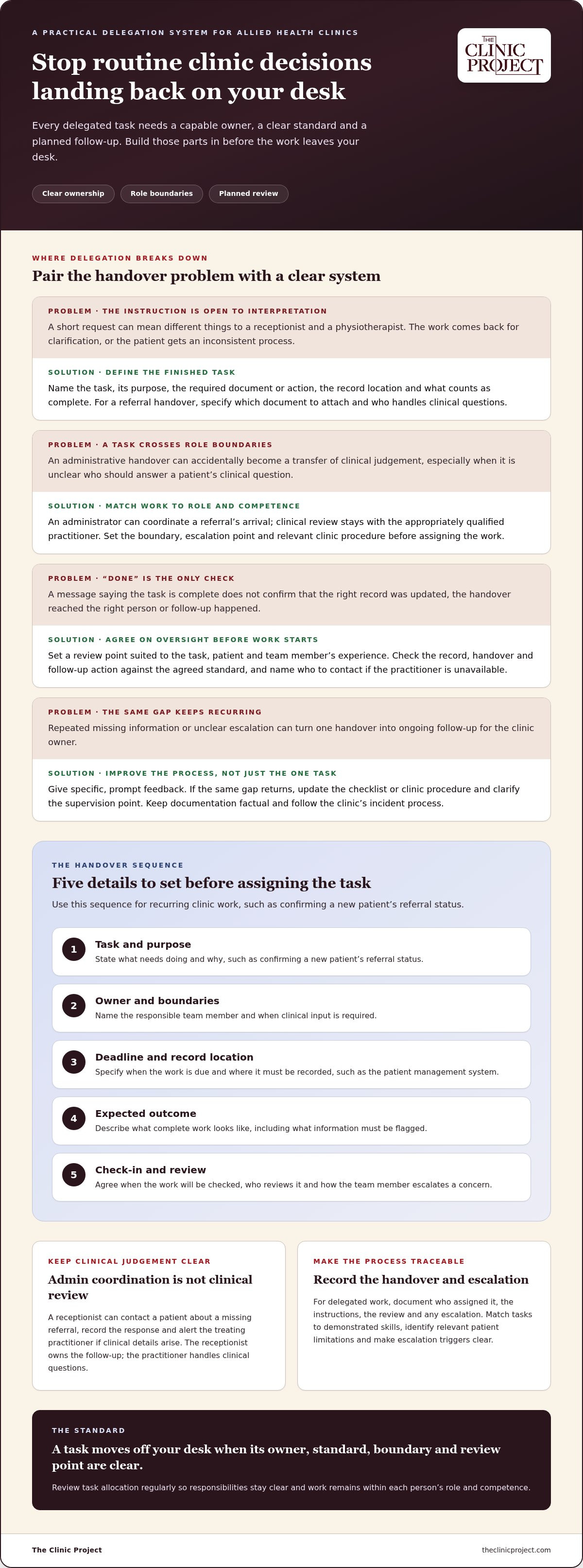
A practical way to delegate in a health clinic is to connect the task’s purpose with its actions, check-in and review point. For example, ask a receptionist to contact a patient about a missing referral, record the response and alert the treating practitioner if clinical details arise. The receptionist owns the follow-up; the practitioner handles clinical questions. Use this sequence for recurring assignments:
- Name the task and purpose, such as confirming a new patient’s referral status.
- Identify the responsible team member and boundaries, including when clinical advice is needed.
- Set the deadline and record location, such as the patient management system.
- Describe the expected outcome and what counts as complete.
- Agree on a check-in or escalation point for unanswered calls or new concerns.
Ask the team member to explain the key steps in their own words before starting. This surfaces gaps while the task is easy to clarify. After completion, review the record and give specific feedback. For clinical responsibilities, align role boundaries with AHPRA’s professional standards and codes, then update the clinic’s handover checklist when a recurring process needs clarification.
Reasons clinic owners struggle to delegate
Delegation often stalls when the owner remains the final approver for every roster change, patient query and fee adjustment. In a clinic with two to six practitioners, this can turn a capable team into a queue of people waiting for one decision. The pressure grows when a full diary leaves little time to document responsibilities or train someone to own recurring work.
Clinical standards matter deeply to allied health owners, so handing over a task can feel like handing over control of the patient experience. A physiotherapist who has refined a referral handover over the years may spot gaps quickly, while a newer administrator needs the steps made explicit. Keep the clinical decision with the appropriate practitioner and delegate the repeatable coordination around it. That boundary protects quality while giving others room to build competence.
Owners can also take work back when the first attempt differs from their preferred method. If a practitioner’s patient follow-up note uses a different format, rewriting it after hours teaches the team to wait for approval. Set the required standard, review against it and allow reasonable differences in style. In my clinic work, I focus on defining what must stay consistent, such as the patient record and escalation point.
Unclear ownership creates another trap. A team member assumes the practice manager is updating the fee schedule, while the practice manager expects the owner to approve it. Name one accountable person and a review date in the task tracker.
For U.S. state-specific delegation guidance, start with the licensing board for the professional’s state and role, then compare its guidance with the relevant professional organisation’s standards. Clinic owners in Australia should use applicable registration and professional guidance for their own roles, rather than apply U.S. state rules.
Before delegating, write down one task you still approve each week, then decide who will own it and what outcome meets your standard. This small transfer can reveal whether the obstacle is skill, unclear authority or your own review habit. Identify the cause, then build the system around it.
The Clinic Project: Set to Scale
The Clinic Project’s Set to Scale helps allied health clinic owners build clearer systems and stronger operational leadership. It’s a relevant next step when delegation keeps bringing decisions back to you, responsibilities remain unclear, or your clinic has grown faster than its processes.
Use the ideas in this article to identify one recurring task that still depends on your approval. Set to Scale can help you consider how that responsibility fits within your wider clinic structure, from role clarity to the systems your team uses to complete the work. The aim is to reduce the clinic’s reliance on the owner for routine decisions.
If you’re ready to work through a bottleneck in your clinic, visit The Clinic Project to explore Set to Scale.
Make the next decision easier to share
Choose one decision that keeps returning to your desk, such as approving a routine roster change or checking a standard patient handover. Write down the result you expect, who can own the decision and what needs your review. Then let the team member handle the next instance within those boundaries.
Learning how to delegate in a health clinic is ongoing leadership work. Your team builds confidence through clear ownership, while you make room to focus on the parts of the clinic that need your judgement. Keep refining the system as roles develop and the clinic changes.
The Clinic Project offers Set to Scale, Impact Mastermind and CEO Weekend events for clinic owners seeking structured support. An Impact Call with Winnie is a useful next step if you want to discuss the delegation bottleneck affecting your clinic.
Book an Impact Call with Winnie. A well-designed handover gives your team a clear next move and gives you space to lead with intention.
Frequently Asked Questions
What happens if you don’t delegate in the clinic?
Without delegation, routine clinic decisions and follow-ups keep competing with your clinical and leadership work. A patient waiting for a referral update, for example, may be affected when every status check depends on the owner’s availability. Over time, team members also get fewer opportunities to develop ownership. The clinic’s ability to provide consistent service becomes closely tied to one person’s attention.
Why is delegating so hard?
Delegation can be difficult when the owner’s expertise is closely tied to the clinic’s quality standards and reputation. A clinic director who built the referral network, for example, may find it hard to hand over relationship follow-ups without knowing how messages will be handled. The practical task is to make the standard observable, so a team member can meet it without copying the owner’s personal style.
Which clinic tasks can be delegated to medical assistants, nurses, and other staff?
Suitable tasks depend on the person’s role, competence, local rules and the task’s clinical risk. In an allied health practice, administrative staff could manage appointment confirmations or check whether intake forms are complete. A qualified practitioner could take on an appropriate clinical task within their scope. Separate preparation and coordination from assessment, advice and decisions, then assign only work the team member is authorised and prepared to perform.
What tasks cannot be delegated by a physician or nurse?
Tasks requiring a professional’s own clinical judgement, assessment or decision-making should remain with that professional. For example, a team member should not be asked to decide whether a patient’s new symptoms require a treatment change unless that decision falls within their professional scope. Delegation limits vary by jurisdiction and role, so distinguish routine support from clinical decisions before assigning work.
How should a clinic assess staff competency before delegating a task?
Assess competence by reviewing relevant training, observing the person perform the task and checking how they respond to an exception. For instance, ask a staff member to practise entering a referral in the correct patient file, then show what they would do if the identifying details do not match. Record demonstrated capability and any further training needed before assigning independent responsibility.
How should clinics document delegated tasks, supervision, and staff training?
Keep a task record that identifies the responsible role, approved process, completed training and supervision arrangement. A clinic procedure for referral follow-ups could specify where to record the task, the boundary for clinical questions and the escalation route. Note review dates and process changes, then keep task-specific patient information in the appropriate clinical record. Follow applicable local recordkeeping requirements for your jurisdiction.

Article by
Winnie Wu
Physiotherapist Winnie Wu builds allied health clinics that are highly profitable and run without their owner. She has founded four health brands. Her two Sydney clinics, Movement Laboratory and the award-winning Papaya Clinic, let her take three to four months off every year. Through The Clinic Project she works directly with women clinic owners on profit, systems and leadership, and her Set to Scale clients average a 32% profit margin, more than double the industry average. Every framework she teaches runs in her own clinics first.