

Multidisciplinary clinic consulting helps Australian allied health owners bring practice operations, specialist teamwork, communication, coaching and technical support into a more coordinated system. The aim is clearer responsibilities, smoother patient handovers and a clinic that relies less on the owner to keep every decision moving.
When your practitioners are busy but you still approve the roster, resolve handover gaps and make the 7pm call on a patient follow-up, growth can feel heavier than it should. That pressure makes sense when several disciplines share patients, rooms and administrative processes.
This article explains what consulting can cover, how to identify which operational issues to address first, and what to look for in a practical approach. You’ll also see how clear systems can support the team’s daily work and help you step back from being the clinic’s default problem-solver.
Key Takeaways
- Map the operational hand-offs between disciplines to find where patient journeys and team workflows lose momentum.
- Separate leadership and communication challenges from process or technical gaps so support addresses the right issue.
- Set clear expectations for referrals, shared patients and clinical handovers across your allied health team.
- Identify when structured business support can help you move from owner-led decisions to more consistent clinic systems.
Practice operations and management
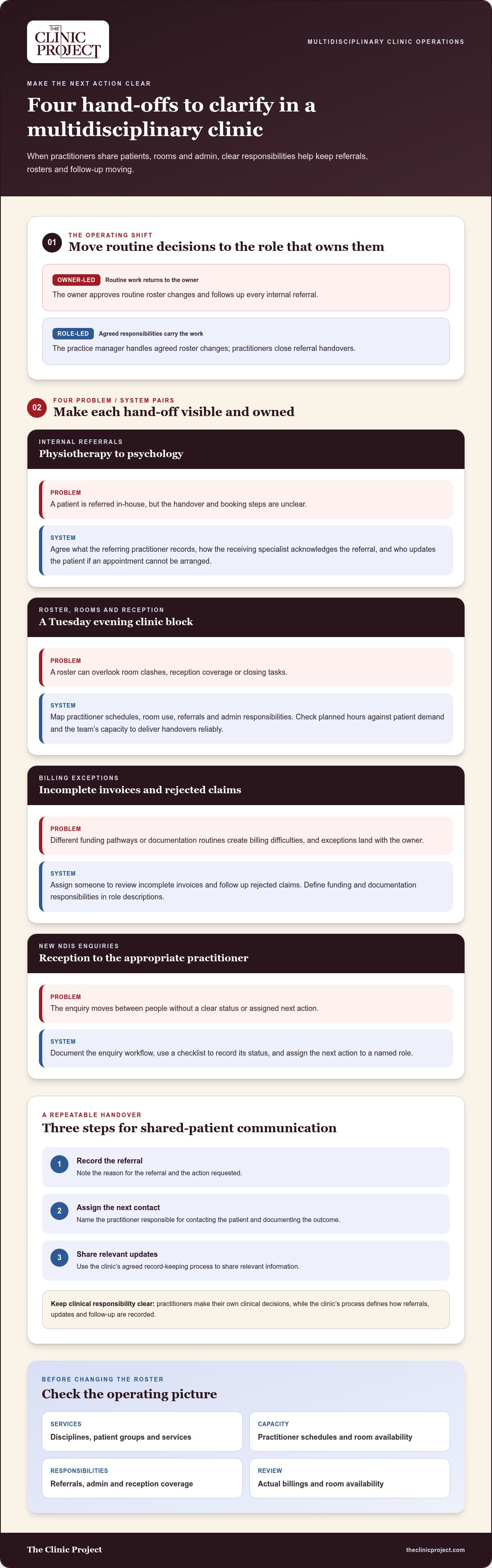
Multidisciplinary allied health clinics coordinate practitioners, rooms and administration across several services. Compared with a single-specialty practice, they need clear processes for shared patients, internal referrals and follow-up responsibilities. For example, when a physiotherapist refers a patient to an in-house psychologist, the handover and booking steps should be clear.
In Australia, plan operations around each discipline’s professional requirements, scope of practice and funding pathways. Map how private health rebates, NDIS or WorkCover administration affects reception tasks, practitioner documentation and patient communications. Define these responsibilities in role descriptions before expanding the team or changing clinic hours.
Plan clinic operations in a practical sequence:
- Define the disciplines, patient groups and services the clinic will support.
- Map practitioner schedules, room use, referrals and administrative responsibilities.
- Set up billing workflows and review routines before changing the roster.
| Operating pattern | What it looks like |
|---|---|
| Owner-led | The owner approves routine roster changes and follows up every internal referral. |
| Role-led | The practice manager handles agreed roster changes; practitioners close referral handovers. |
Compare the plan with actual billings and room availability before adding sessions.
Billing difficulties can arise when services use different funding pathways or documentation routines. Assign someone to review incomplete invoices and follow up rejected claims, rather than leaving the owner to resolve every exception.
Common project risks include unclear decision-making, room clashes and growth plans that exceed reception capacity. A Tuesday evening clinic block, for example, needs a roster that covers reception and closing tasks as well as appointments. Set operating hours around patient demand and the team’s capacity to deliver each handover reliably.
The Northwestern Medicine Head and Neck Multidisciplinary Clinic is closed on Saturdays and Sundays, an example of how operating hours vary by clinic. When setting a roster, compare the planned hours with your clinic’s schedule and make sure handovers, room use and reception coverage fit.
Coaching and technical assistance
Coaching helps allied health owners turn business priorities into clear decisions. Technical assistance helps the team put those decisions into everyday clinic processes.
Consultant selection criteria
Choose a consultant who understands how allied health disciplines work together and can connect advice to your clinic’s operations. If reception is unsure how to process a referral between physiotherapy and psychology, ask how the consultant would clarify responsibilities, support the relevant team members and assess whether the change works. Look for a defined process, practical outputs and clear ownership.
For an Australian clinic, discuss how the approach will account for your service mix, practitioner roles and patient funding pathways. It should respect each practitioner’s clinical judgement while helping owners and managers make business decisions with greater clarity.
Consulting services offered
Support can include leadership guidance, operational reviews, team communication processes and help with administrative workflows. For example, a consultant could map how a new NDIS enquiry moves from reception to the appropriate practitioner, then help create a checklist to record its status and assign the next action.
Technical assistance should address a defined operational problem. A consultant can help document a repeatable process, configure existing tools to support it and train the people who use it. The clinic remains responsible for selecting and managing its systems and making clinical decisions.
Before work begins, agree on the problem, the practical output and who will maintain it:
- Describe the recurring clinic problem, such as delayed enquiry follow-up.
- Assign an owner and document the agreed workflow.
- Review how the team uses the process and address breakdowns.
For owners who want to clarify their next business priority, a structured clinic strategy conversation can help focus the discussion on the clinic’s needs.
HMA’s emergency department opioid-use-disorder support included assessing clinical processes, developing electronic medical record tools and addressing barriers to medication-assisted treatment prescribing. It shows how technical assistance can link an operational review with practical tools and implementation support. A clinic can use the same planning approach: identify where a process becomes difficult, specify what tool or guidance would help, and decide who will carry the work forward.
Teamwork and communication among specialists
In an allied health clinic, teamwork depends on practitioners knowing when to share information and who owns the next action. When a physiotherapist refers a patient to an occupational therapist, the handover, consent process and follow-up owner should be clear. Without these steps, useful clinical knowledge can remain with one practitioner instead of supporting coordinated care.
Set a shared communication standard for referrals between disciplines. Agree what the referring practitioner records, how the receiving specialist acknowledges the referral and who updates the patient if an appointment cannot be arranged. Keep the process visible in a handover checklist instead of relying on a corridor conversation.
Use team meetings to resolve cross-discipline questions that affect patient pathways. A speech pathologist and psychologist supporting the same child can clarify their respective goals, identify overlap and agree how progress updates reach the family. Each practitioner remains responsible for their own clinical decisions.
Make the communication routine specific:
- Record the referral reason and the action requested.
- Assign a practitioner to contact the patient and document the outcome.
- Share relevant updates through the clinic’s agreed record-keeping process.
This structure supports both patients and practitioners. Patients know who will contact them next, while specialists can see whether a referral was received and actioned. Leaders can review missed handovers and improve the process without making the clinic owner the default messenger.
According to Mayo Clinic, stage three colon cancer has traditionally required multidisciplinary care involving different specialists. Mayo Clinic also describes rare-cancer teams that can include radiologists, pathologists, radiation oncologists, medical oncologists and surgical specialists. Allied health clinics work across different disciplines, but the practical principle is the same: define each person’s contribution and build communication into the care pathway.
Knowledge-sharing becomes reliable when the clinic records decisions, assigns actions and follows up with patients. For example, document the referral outcome before the next team discussion so the meeting can focus on unresolved needs instead of piecing together what happened.
What services do multidisciplinary clinic consulting firms offer?
The consulting scope should match the clinic’s actual bottleneck. A paediatric allied health practice adding occupational therapy, for example, needs a plan for service design, team roles and patient pathways. Consulting can also address leadership routines, financial visibility, marketing capacity and systems that support consistent service delivery.
Common areas of support include:
- Operational review: map administration, room use and practitioner workflows, then identify where decisions stall.
- Leadership development: clarify what the owner, practice manager and discipline leads decide independently.
- Team structure: define responsibilities for supervision, onboarding and cross-discipline coordination.
- Financial planning: review practitioner utilisation, service mix and the effect of private health, NDIS or WorkCover workflows.
- Growth planning: match patient demand and marketing activity to the team’s capacity and available rooms.
Useful consulting produces practical outputs, such as a decision-rights guide, onboarding checklist or monthly performance dashboard. For example, a practice manager could own the weekly review of unfilled appointment blocks, while the owner retains decisions about hiring and service direction. The consultant can help design this structure and support its implementation.
Before work starts, agree on the problem, deliverables and review method. A clinic could focus on reducing owner approvals for routine roster changes, then track whether the new approval process is being followed. Keep clinical judgement with the relevant practitioners and use consulting to strengthen the business systems around their work.
Choose support that reflects your clinic’s stage and team structure. A small practice with two disciplines needs a different plan from a larger clinic with several discipline leads. If you’re ready to discuss your clinic’s operational priorities, Book an Impact Call with Winnie.
The Clinic Project: Set to Scale
The Clinic Project supports allied health owners seeking clearer business systems, stronger leadership and practical direction for their next stage. If your clinic is in the Messy Middle, with a busy team but routine decisions still coming to you, Set to Scale can help you structure operations and establish more consistent ways of working.
For owners leading larger teams, Impact Mastermind offers a forum to work through strategic business challenges with peers. Hybrid Fast Track can help when you’re ready to develop a hybrid program that extends your clinic’s services beyond room-based appointments.
Choose support based on the decision in front of you, whether it concerns operational structure, leadership priorities or a hybrid service model. To explore the right next step for your clinic, contact The Clinic Project.
Choose the next decision to systematise
Choose one operating decision that still comes back to you, such as approving a practitioner’s roster change or resolving an internal referral delay. Write down who can make the decision, what information they need and where to record the outcome. This gives your team a practical starting point for building clinic systems that rely less on the owner.
Multidisciplinary clinic consulting is most useful when it turns an identified pressure point into a process your team can use consistently. Start with a single workflow, clarify who owns it, then build on that foundation as your leadership structure develops. This deliberate approach keeps improvement connected to how your allied health clinic actually operates.
If you’re ready to identify the right next step for your clinic, Book an Impact Call with Winnie. A clear starting point can make the work ahead feel more manageable.
Frequently Asked Questions
What does a multidisciplinary clinic consultant do?
A multidisciplinary clinic consultant helps owners strengthen the business systems that support allied health care. They can assess how leadership decisions, practitioner capacity and service mix affect the clinic, then help turn priorities into practical plans. For example, if adding psychology appointments puts pressure on reception, the consultant can help clarify workloads, responsibilities and decision-making before the change becomes part of the regular roster.
How should a multidisciplinary clinic structure teams, referrals, and care coordination?
Structure the team around clear roles, agreed communication channels and patient needs. A role guide can identify who receives referrals, who coordinates shared care and which decisions belong to each discipline lead. In a paediatric clinic, regular case discussions can align practitioners’ goals for a child while keeping each clinician accountable for their own care. Give the practice manager responsibility for maintaining the operational process.
How can a multidisciplinary clinic measure performance and patient outcomes?
Use a balanced dashboard that connects clinic operations with patient progress. Track measures such as practitioner utilisation, appointment access, cancellations, service mix and whether patients report progress towards agreed goals. Review these measures consistently, then investigate meaningful changes by discipline or service pathway. For example, lower utilisation in one service alongside longer waits in another could prompt a roster review, while patient feedback helps show whether operational changes support a better care experience.

Article by
Winnie Wu
Physiotherapist Winnie Wu builds allied health clinics that are highly profitable and run without their owner. She has founded four health brands. Her two Sydney clinics, Movement Laboratory and the award-winning Papaya Clinic, let her take three to four months off every year. Through The Clinic Project she works directly with women clinic owners on profit, systems and leadership, and her Set to Scale clients average a 32% profit margin, more than double the industry average. Every framework she teaches runs in her own clinics first.