


A psychology practice business consultant helps clinic owners identify business bottlenecks and decide what to address first. Your diary is full, the team is waiting for approval on routine decisions, and you’re still answering operational messages after the last appointment. The clinic may be busy, but your attention is still holding the working week together.
That pressure can leave little room to think about how consulting fits alongside clinical work, or how people and business systems affect each other. You don’t need another broad list of ideas. You need a clear way to assess the problem, choose the right support and put useful changes into practice. This article explains how business consulting can address clinic challenges, support owners balancing clinical and leadership work, and connect people-focused insight with practical business decisions. It also helps you identify a next step that fits your priorities.
Key Takeaways
- Trace recurring business problems to their underlying causes, then choose a practical measure to show whether your response is working.
- Set clear boundaries between consulting and clinical work so each has protected time and a defined purpose.
- Use coaching to turn insight into specific leadership actions, such as clearer delegation and more consistent team handovers.
- Separate people and culture challenges from financial and operational decisions, while recognising when both need to be addressed together.
Helping clients identify and address business problems
I help clinic owners look for the operational cause behind recurring problems and choose a practical response. If every roster change needs your approval, for example, I’d look at decision-making authority and role clarity before changing the roster. That helps distinguish a systems issue from a people issue.
When planning a psychology practice, work through the business model, service mix, fees, referral pathways and workflows. For example, trace an enquiry from the first call to the booked appointment, noting where responsibility changes hands. The map shows where you can make a specific improvement.
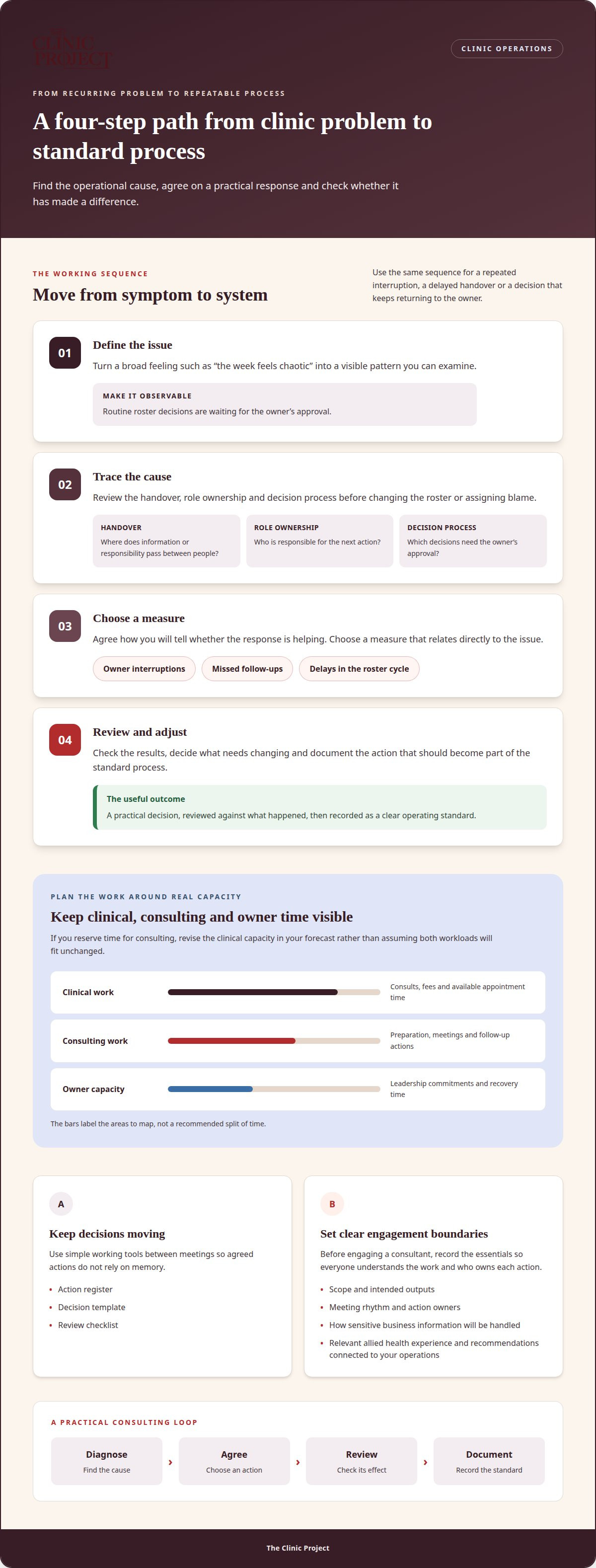
I use four steps to move from problem to action:
- Define the issue. I turn “the week feels chaotic” into a visible pattern, such as routine roster decisions waiting for the owner.
- Trace the cause. I review the handover, role ownership and decision process before recommending a change.
- Choose a measure. I agree how we’ll assess progress, such as tracking owner interruptions or missed follow-ups.
- Review and adjust. I use the results to decide which action belongs in the standard process.
Consulting fees should reflect the scope and value of the work, including its complexity, the expertise required and the practical benefit to the clinic. A clear agreement should set out the work, intended outcomes and boundaries, so both parties understand what the engagement covers.
Strong client relationships benefit from purposeful contact, a meeting agenda, a written decision log and a named organisational contact. To reach potential consulting clients, share practical insights through professional networks and referral relationships.
Between meetings, tools such as an action register, decision template and review checklist help clients apply advice without relying on memory. They also keep agreed work moving between discussions.
A repeatable consulting process brings the work together: diagnose the cause, agree on an action, review its effect and document the new standard. This keeps each engagement focused on a real business problem.
Balancing consulting with private practice
Consulting and clinical work draw on the same time and attention. Protect clinical sessions first, then reserve defined blocks for advisory work and preparation.
Financial benchmarks and revenue projections
Assess billings alongside capacity, costs and the owner’s time. Treat that as a planning reference, then build a forecast around your actual roster and service mix.
| Planning view | What to map |
|---|---|
| Clinical work | Consults, fees and available appointment time |
| Consulting work | Preparation, meetings and follow-up actions |
| Owner capacity | Leadership commitments and recovery time |
If you reserve time for consulting, revise the clinical capacity in your forecast rather than assuming both workloads will fit unchanged.
Risks when hiring a consultant
Look for a clear scope, relevant allied health experience and recommendations connected to your actual operations. Before engaging a consultant, record the problem, agreed outputs, meeting rhythm and who will own each action. Clarify how sensitive business information will be handled, and make sure the advice complements your clinical and professional responsibilities.
Before opening a psychology practice in Australia, map the business structure, services, budget, referral pathway and booking workflow. Keep consulting blocks separate from clinical appointments, for example by setting aside Tuesday afternoon for client calls and Friday morning for preparation. Review your calendar weekly so advisory work doesn’t quietly displace patient care or leadership duties.
If you want to discuss how consulting could fit your clinic’s priorities, book an Impact Call.
Consulting can be structured as a substantial but bounded part of a working week. Consultant Michael Fresé works 20 hours a week and reports pulling in six figures. That example offers a point of comparison, not a forecast for another clinic: the owner’s available time, clinical capacity and costs still shape what is workable. Use reported outcomes as context while testing a proposed schedule against your own practice’s priorities, and keep the clinical commitment visible when adjusting advisory hours.
Consultants as coaches and problem-solvers
A consultant can coach you through a decision and help turn it into an operational change. In a psychology clinic, that might mean clarifying who handles a cancellation, who contacts the client and who updates the diary.
Coaching is most useful when each conversation ends with an action you can observe. Use this sequence to move from discussion to execution:
- Name the decision. For example, decide who approves a change to the weekly practitioner roster.
- Surface the options. Compare owner approval with a written delegation rule for routine changes.
- Choose a strategy. Set the boundary, the responsible role and the information needed to decide.
- Review the result. Check the next roster cycle for delays, repeated questions or missed handovers.
Leadership coaching can include self-reflection, journalling, assessment inventories and stakeholder feedback. For example, ask a practice manager and clinicians where a handover breaks down, then compare their observations with your own. The difference may point to a process problem rather than an individual performance issue.
Consulting can also address candidate screening, work-group dynamics and organisational culture. If new starters receive different instructions from different clinicians, map onboarding from the first shift through the initial review. A shared checklist gives the team one standard and the owner a clear way to assess consistency.
Effective strategies account for both the owner and the team. Owners need clear decision-making authority and fewer interruptions; clinicians need reliable guidance about when to act independently. A written escalation pathway can distinguish a routine diary adjustment from a concern that needs the owner’s input.
This week, choose a recurring decision and document its trigger, owner and next action. Use the next team meeting to check whether everyone understands the process. A consultant’s value is reflected in changes the team can repeat, not advice that stays in meeting notes.
A consultant may move between coaching, problem-solving and strategic advice as the client’s needs change. Leadership coaching can combine models with self-reflection, journalling, assessment inventories and stakeholder feedback to identify strengths and areas to develop. Together, these approaches connect a client’s growth with the practical challenges they need to address.
Overlap between consulting and business psychology
Consulting and business psychology overlap when a clinic problem involves both people and systems. A missed handover, for example, may stem from unclear responsibilities, team expectations or a workflow that depends on the owner.
Compared with a general small-business consultant, a psychology practice consultant should understand how clinical services shape staffing, appointment delivery and patient experience. Business psychology adds a people-focused lens, helping identify how leadership, team dynamics and workplace culture affect the organisation. Financial decisions still need operational analysis, not assumptions about psychology alone.
For an Australian psychology practice, map the relevant AHPRA registration, privacy, records, employment, tax and business requirements. Treat these as distinct areas to address, then build them into practical processes, such as access controls for client records and a documented onboarding checklist. A consultant can help organise the business work, while clinical and regulatory responsibilities remain with the appropriate professionals.
Connect the people and process sides through a short review:
- Describe the pattern. Note where a client enquiry stalls, such as between reception and the practitioner.
- Ask the people involved. Compare the practice manager’s account with the clinician’s handover experience.
- Find the system cause. Check whether the booking workflow, role boundaries or written guidance creates the gap.
- Implement one change. Assign enquiry follow-up to a named role and record the next action in the clinic’s process.
- Review the effect. Look for fewer unresolved enquiries and clearer ownership during the next team review.
This approach avoids treating every people issue as a performance problem or every operational issue as a software problem. For example, if clinicians interpret a cancellation policy differently, clarify the patient-facing message and the team’s decision pathway together. Use leadership coaching when communication or delegation is the barrier, and operational redesign when the workflow itself creates friction.
If you’re weighing a business bottleneck that spans leadership and systems, Book an Impact Call with Winnie.
The Clinic Project: Set to Scale
The Clinic Project’s Set to Scale helps allied health clinic owners strengthen business systems, develop clearer leadership and improve profitability. It can be a relevant next step when you’ve identified pressure points and want structured guidance to turn insights into consistent changes.
If your focus is developing a hybrid service, Hybrid Fast Track helps you develop and sell a hybrid program.
Choose support that matches your clinic’s current challenge and capacity. Explore The Clinic Project’s programs and services to decide on a practical next step.
Choose the next decision to move forward
Start with a business decision that keeps returning to your desk. Identify what information, authority and process would help your team handle it confidently. A psychology practice business consultant can then focus on a defined challenge, while you retain a practical way to assess whether the change is useful.
Begin with the decision that most often interrupts your clinical or leadership time, rather than adding another broad project to an already full week. Then choose support that fits your needs, whether that means structured guidance, peer discussion or dedicated time to think. The Clinic Project’s CEO Weekend offers focused time for strategic business planning.
Bring one live business challenge to an Book an Impact Call with Winnie conversation and consider a practical next step. You can move forward with greater clarity, one decision at a time.
Frequently Asked Questions
How much does a psychology practice business consultant cost?
The cost depends on the case and is given after a quote request. Factors include the scope of advice, the complexity of the practice’s needs, the work involved and the format of support. Before committing, define the decision you need help with, the deliverables you expect and how you’ll assess whether the engagement was useful.
How can a consultant help grow a psychology practice and attract clients?
A consultant can help match client acquisition activity to your clinic’s capacity and identify which channels bring suitable enquiries. For example, compare referral sources and enquiry outcomes, then refine what prospective clients see about your services, fees and booking process. Clear messaging and a manageable follow-up routine can support a consistent patient experience without creating demand your team cannot serve.

Article by
Winnie Wu
Physiotherapist Winnie Wu builds allied health clinics that are highly profitable and run without their owner. She has founded four health brands. Her two Sydney clinics, Movement Laboratory and the award-winning Papaya Clinic, let her take three to four months off every year. Through The Clinic Project she works directly with women clinic owners on profit, systems and leadership, and her Set to Scale clients average a 32% profit margin, more than double the industry average. Every framework she teaches runs in her own clinics first.