
The CEO Weekend: Strategic Intensive for Clinic Owners

A clinic can be fully booked and still depend on its owner to approve a roster change, answer a late patient question and settle a fee decision. For CEO weekend clinic owners, the value lies in turning those recurring decisions into a practical roadmap that fits the clinic’s real operating conditions.
Two days away from the clinic are useful when they give you space to resolve a live business question and plan how the work will continue afterwards. I run Movement Laboratory and Papaya Clinic, so I know strategic decisions need to fit the roster, team capability and owner commitments. This article will help you assess whether a CEO Weekend suits your current stage, prepare the information that will make the work specific and choose priorities you can carry into the clinic. You won’t be here without strategy.
Key Takeaways
- A CEO Weekend can suit clinic owners whose roster, fee and team decisions still rely heavily on their approval.
- Use the intensive to develop a roadmap grounded in your clinic’s finances, team responsibilities and growth priorities.
- Prepare by naming one bottleneck, gathering the relevant clinic information and listing the decisions you want to resolve.
- Bring your current priorities, team structure, fee schedule and handover processes to make the strategic work specific and actionable.
Is a CEO Weekend for clinic owners the right strategic intensive?
A CEO Weekend is a two-day, in-person strategic intensive for clinic owners to step back from daily patient care and work on the business. It can suit an allied health clinic owner whose team is capable but still relies on her to approve routine decisions, resolve escalations and keep the week running.
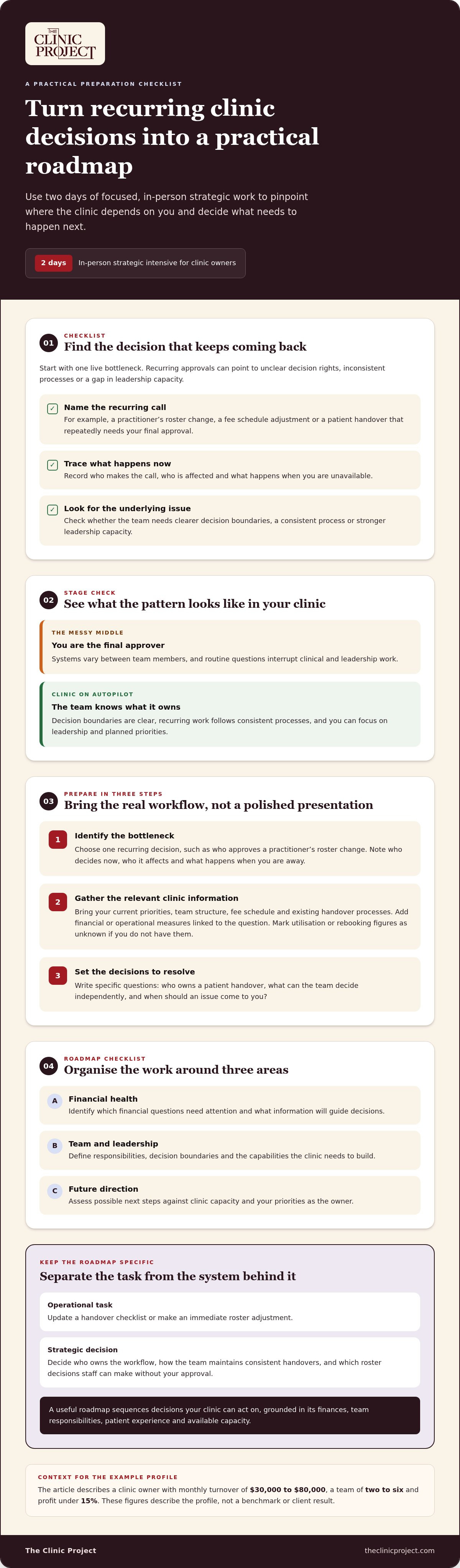
Use a practical fit test: list the decisions that keep returning to you. If a practitioner’s roster change, a fee schedule adjustment or a patient handover repeatedly needs your final approval, the underlying issue may be unclear decision rights, inconsistent processes or a gap in leadership capacity. A focused strategy session gives you time to work out which one is driving the bottleneck.
What signals that your clinic needs dedicated CEO time?
Your calendar often reveals the constraint. Clinical appointments fill the week, staff questions land in the gaps and business planning gets pushed into the evening. You might find yourself making a 7pm decision about a position’s hours, then rewriting the follow-up checklist because the team uses different steps after an initial appointment.
Picture a clinic where the reception lead escalates every roster adjustment and clinicians wait for the owner to approve patient handovers. The useful question is what would allow those decisions to happen consistently without the owner’s involvement every time. That could mean clarifying who owns the workflow, setting boundaries for decisions the team can make, or building leadership capability in a key role.
Strategic planning involves setting direction and deciding how to allocate resources. In an allied health clinic, those decisions need to account for practitioner capacity, patient experience, team responsibilities and the owner’s available time.
- The Messy Middle: The owner is the final approver, systems vary between team members and routine questions interrupt clinical and leadership work.
- Clinic on Autopilot: Team members know which decisions they own, consistent processes guide recurring work and the owner can focus on leadership and planned business priorities.
I approach this as a clinic founder and allied health strategist. A plan needs to work within real clinical and team commitments, not sit apart from them. CEO Weekend provides dedicated time to examine where the clinic depends on you and map a practical direction from there.
What strategic work can clinic owners do at a CEO Weekend?
A CEO Weekend gives clinic owners focused time to work on the business and develop a practical roadmap towards greater operational autonomy. The central task is to distinguish which priorities need your judgement, which responsibilities belong with the team and what needs to happen first.
Which clinic decisions belong in the roadmap?
Start with decisions that affect the clinic’s direction, capacity or ability to operate consistently. Reviewing a fee schedule is strategic when you are assessing how fees support the clinic’s services and operating priorities. Updating a handover checklist is operational; deciding who owns the process and how the team will maintain consistent handovers belongs in the roadmap.
The same distinction applies to a 7pm message about tomorrow’s practitioner roster. The immediate adjustment is routine. The repeated need for your approval points to a bigger question about decision rights, escalation rules or who leads workforce planning. Record both the owner’s responsibilities and the team’s authority, so staff know when to act and when to bring a decision to you.
I’m Winnie Wu, a clinic founder and allied health strategist. I test my frameworks in Movement Laboratory and Papaya Clinic, where plans have to account for practitioner capacity, patient handovers and the work required to keep a clinic operating. That operator’s perspective keeps strategic discussions connected to what your team can put into practice.
Organise the roadmap around three areas:
- Financial health: identify which financial questions need attention and what information will guide decisions.
- Team and leadership: define responsibilities, decision boundaries and the capabilities the clinic needs to build.
- Future direction: assess possible next steps against clinic capacity and your priorities as the owner.
A sequenced plan gives you a way to make the next decisions, rather than a collection of disconnected ideas. The SBA guide to writing a business plan also describes planning as a way to organise how a business runs and develops. If you want to explore how this strategic work could fit your clinic, start a conversation about your clinic priorities.
How should you prepare for a CEO Weekend as a clinic owner?
Good preparation starts with a live clinic bottleneck, the information that helps explain it and the decisions you want to resolve. Bring a clear picture of how work moves through the practice, rather than a polished presentation or a long list of ideas.
What should you bring into strategic planning?
Use this three-step process to focus your preparation:
- Identify the bottleneck. Choose one recurring decision, such as who approves changes to a practitioner’s roster. Record who makes the call now, who is affected and what happens when you are unavailable.
- Gather relevant clinic information. Bring your current priorities, team structure, fee schedule and existing handover processes. Add financial or operational measures that relate to your question. If utilisation or rebooking figures are unavailable, mark them as unknown rather than estimating.
- Set the decisions to resolve. Write down specific questions, such as who owns a patient handover, what the team can decide independently and when an issue should come to you.
For example, an owner in the reader profile might have monthly turnover of $30,000 to $80,000, a team of two to six and profit under 15%. These figures describe the profile, not a benchmark or a client result. Trace one real workflow, such as a handover from an initial allied health appointment to the next clinician, and note where responsibility becomes unclear.
I bring an operator’s perspective to this work: a plan has to fit the team, the patient pathway and the clinic’s actual capacity. Take your chosen workflow and the relevant information into CEO Weekend, then define an owner, a next action and a review point for each priority.
Discuss the strategic question you are preparing to resolve with Winnie.
What is the next step after deciding a CEO Weekend fits?
Before beginning strategic work, identify a question worth focused attention, be ready to examine how the clinic operates and leave room in your calendar to act on the priorities afterwards. A useful question could be how to give a capable team more ownership while maintaining consistent patient care.
CEO Weekend is a two-day, in-person learning and deep-work experience led by Winnie Wu. It focuses on strategic planning for greater operational autonomy, shaped around the realities of your allied health clinic. Include follow-through in your plan: set time to review progress and involve the people responsible for putting decisions into practice.
How does CEO Weekend differ from a clinic owners retreat?
Choose the experience according to what you want the time to support. CEO Weekend centres on strategic planning and focused work on the clinic business. The Clinic Owners Retreat brings together rest, play, mastermind and deep work, with a broader mix of priorities.
If you want concentrated attention on business direction, CEO Weekend is the closer fit. If you value an experience that includes rest and play alongside mastermind and deep work, the retreat has a different emphasis. Clarify your priority before deciding, then protect time afterwards to carry the relevant work into your clinic.
Give your strategic work a clear next step
Choose one decision that currently depends on you and define what progress would look like in practice. That could mean agreeing who can approve a roster adjustment, setting a review point for the fee schedule or assigning responsibility for maintaining a patient handover process.
Put time in your calendar to revisit the decision once you are back in the clinic. Involve the relevant team members, clarify who owns the next action and record where your input is needed. A defined review point keeps the work connected to the weekly realities of patient care and team leadership.
If you are ready to explore whether CEO Weekend fits your clinic priorities, start a conversation with Winnie. Bring one live decision and begin there.
Frequently Asked Questions
Is CEO Weekend suitable for an allied health clinic owner in the Messy Middle?
Yes, it can suit clinic owners whose business has become more complex while strategic decisions still rely on them. The Messy Middle: the growth stage where clinics expand but systems break and owners burn out. Fit depends on the bottleneck you want to examine and the strategic work you are ready to undertake. Attending alone does not guarantee a particular result.
What happens during CEO Weekend?
CEO Weekend is a two-day, in-person intensive centred on strategic planning and working on the business. Clinic owners have dedicated time for learning and deep work, with the aim of developing a roadmap for greater operational autonomy. Winnie leads the experience directly. The Clinic Project works with allied health clinic owners in Australia, New Zealand, Canada, Hong Kong and Singapore, with strategic priorities grounded in each clinic’s circumstances.
How should I prepare for a CEO Weekend?
Prepare a short decision brief alongside the records you already use. Describe the issue in observable terms, such as patient handovers waiting for owner sign-off, then state the decision you want to resolve and what information could guide it. Bring source reports rather than rounded estimates. Label missing utilisation, rebooking or profit data as unknown so strategic discussions are based on what you know.
How is CEO Weekend different from a Clinic Owners Retreat?
Choose CEO Weekend when your priority is focused strategic planning and work on the clinic business. The Clinic Owners Retreat combines rest, play, mastermind and deep work, giving the experience a different emphasis. Before deciding, name what you need from the time away: focused work on business direction or an experience that includes rest and play alongside mastermind work.

Article by
Winnie Wu
Physiotherapist Winnie Wu builds allied health clinics that are highly profitable and run without their owner. She has founded four health brands. Her two Sydney clinics, Movement Laboratory and the award-winning Papaya Clinic, let her take three to four months off every year. Through The Clinic Project she works directly with women clinic owners on profit, systems and leadership, and her Set to Scale clients average a 32% profit margin, more than double the industry average. Every framework she teaches runs in her own clinics first.