

Allied Health Practice Systems: 5 Steps to Consistency

Private practice systems and structure determine whether routine decisions, patient handovers and financial checks rely on the owner or have clear owners across the clinic.
A full diary can still leave you carrying every decision. If growth has added complexity while profit and freedom have slipped, roles, handovers and operating procedures may not have kept pace.
I’m Winnie Wu, physiotherapist, clinic founder and systems architect. Since 2022, I’ve grown two clinic brands while taking three to four months off each year. You won’t be here without strategy. The Clinic Freedom Framework connects strategy, people and systems through the pillars of Profit, People and Possibilities, helping you build a clinic that runs with less dependence on you.
Key Takeaways
- Private practice systems and structure should match your clinic’s stage, with clear ownership for the work your team handles now.
- The Clinic Freedom Framework helps you identify where decision-making still depends on you and what needs to change.
- Audit one patient journey, such as referral follow-up, then assign an owner and document the handover standard.
- You won’t be here without strategy. Set direction and clarify role ownership before adding tools or complexity.
Private practice systems and structure in the Messy Middle?
For an established allied health clinic, systems and structure turn strategy into clear responsibilities, decisions and repeatable work. The Messy Middle: the growth stage where clinics expand but systems break and owners burn out. Full books can coexist with weak profit and limited freedom when routine approvals and handovers still depend on you. Busyness alone does not show that a clinic is growing well.
How can you tell your clinic structure depends too heavily on you?
A roster change waiting for your 7pm approval shows that an operational decision has no clear owner. Clinicians own decisions about patient assessment and care within their scope; a designated team member can manage routine roster changes within agreed parameters. You set those parameters and review exceptions.
When decision rights are unclear, the team waits, patients can receive inconsistent updates and routine work follows you into the evening. Strategy establishes the priorities and boundaries that let the team act consistently while clinical judgement stays with the treating practitioner.
What does a more reliable clinic structure make possible?
A dependable structure makes the patient journey visible: who follows up a new referral, who confirms the next appointment and what information passes between practitioners. A handover standard can specify where to record the patient’s next step and who follows up when they leave without rebooking. The team follows the standard, and you review whether it works.
As a clinic founder and systems architect, I design operations around Profit, People and Possibilities. Clear ownership supports patient experience, team consistency and deliberate financial decisions. It also creates room for strategic leadership, including deciding how your time is divided between clinical work and running the clinic.
How should private practice systems and structure change by clinic stage?
The Clinic Freedom Framework: a stage-aware guide to matching your clinic’s strategy, roles and operating systems to its current needs. Its stages are Startup, Accelerated Growth, Messy Middle, Clinic on Autopilot, and Diversify and Fly. Each stage has different priorities. An established clinic needs clear decision ownership, while a startup needs sound foundations.
Messy Middle: routine decisions still return to the owner, delegation varies across the team, and processes often live in people’s heads. Clinic on Autopilot: agreed decision limits help the team resolve routine operational issues, responsibilities are delegated, and documented processes guide work such as referral follow-up and rebooking.
Use the three pillars as operating questions: Profit: does the budget show whether billings support clinic costs and the director role? People: does each recurring task have a clear owner, including patient handovers? Possibilities: do your systems create room to improve the clinic without adding complexity before the team is ready?
Which systems matter most in the Messy Middle?
Start with role clarity, effective delegation and documented standard operating procedures. The practice manager is the owner’s most important hire. Map the patient journey from referral enquiry to rebooking, then specify who follows up enquiries and shares relevant clinic information. Automate steps when they support a consistent patient experience, with a named person accountable for exceptions.
How do you connect structure with profit and capacity?
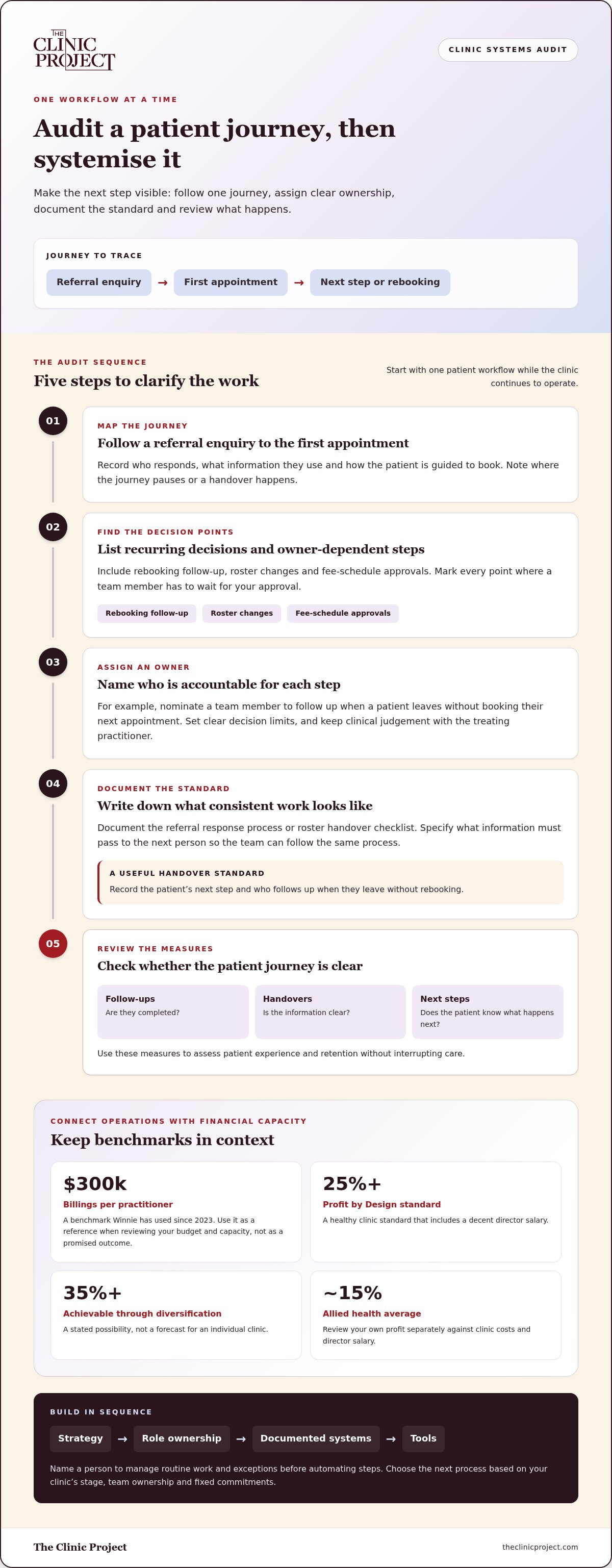
Budgeting and revenue generation belong alongside reputation and patient care. I’ve used $300k billings per practitioner as a benchmark since 2023. Use it as a reference point when reviewing your own budget and capacity, not as a promised outcome. Profit by Design sets a healthy clinic standard at 25%+ profit including a decent director salary, with 35%+ achievable through diversification; the allied health average is around 15%. These benchmarks are not a forecast for your clinic.
For clinic owners in the Messy Middle with under $1.4M turnover, Set to Scale Accelerator focuses on building stronger systems and structure.
How can you audit private practice systems and structure without disrupting patient care?
Audit one workflow at a time while the clinic continues to operate. Private practice systems and structure are easier to improve when you can see where a patient, a decision or a handover pauses, and who is responsible for the next step.
- Map a patient journey. Follow a referral enquiry through to the first appointment. Record who responds, what information they use and how the patient is guided to book.
- List recurring decisions. Include rebooking follow-up, roster changes and fee-schedule approvals. Mark each point where a team member has to wait for you.
- Assign an owner. Name who handles each step, such as following up when a patient leaves without booking their next appointment.
- Document the standard. Write down the referral response process or roster handover checklist, including what information must pass to the next person.
- Review measures. Check whether follow-ups are completed, handovers are clear and patients know their next step. These measures help you assess patient experience and retention without interrupting care.
Then connect the operational audit to financial capacity. Compare your practitioner billings with the $300k benchmark I’ve used since 2023, then review profit separately against your costs and director salary. For example, if referral follow-up is regularly delayed because every exception comes to you, assign a team member to manage routine follow-up and record exceptions for review. The change gives you a practical way to assess the process using information the clinic already collects.
Choose the next process to systemise based on your clinic’s stage, the team member who can own it, and your fixed commitments and energy patterns. For deeper implementation guidance, see our private-practice systemisation guide. You can talk with Winnie about Set to Scale Accelerator.
What is the next step towards private practice systems and structure that run without you?
Build in sequence: strategy, role ownership, documented systems, then tools. Without that order, an automation can speed up an unclear handover or send more routine decisions back to you. Strategy sets the priorities and decision boundaries that make each process useful.
How does strategy make operational change more coherent?
The Clinic Freedom Framework connects a clinic’s stage with the work it needs next. Its three pillars, Profit, People and Possibilities, keep the design practical: check the numbers behind a fee-schedule decision, name who owns the roster handover, then identify what capacity those systems create for future plans.
I test the systems I teach in my own clinics and work directly with clients to adapt the approach to their clinic stage. For owners in the Messy Middle with under $1.4M turnover, Set to Scale Accelerator supports the work of building this structure.
What should the clinic owner do after the audit?
Choose one recurring bottleneck, such as referral follow-up waiting for your approval. Assign a role to own the next step, document the standard for contacting the patient and recording the outcome, then review the process using data the clinic already collects. A regular check-in on enquiry follow-up, rebooking and handover completion shows where the standard needs attention without imposing a made-up target.
Match the next change to your clinic’s priorities and your fixed commitments. Clear systems and structure give your team reliable ways to act and give you more room for strategic leadership.
Book an Impact Call with Winnie
Build a clinic that can run with less dependence on you
Private practice systems and structure become dependable when strategy sets the direction, roles carry clear ownership and documented processes guide recurring work. Start with one bottleneck, such as referral follow-up or the roster handover, and review existing clinic data to see whether the agreed standard is working.
The Clinic Freedom Framework connects decisions about Profit, People and Possibilities with the clinic’s stage, so each improvement supports patient experience and business sustainability. Set to Scale members average a 32% profit margin against an industry average of around 15%. This is a reported program average, not a forecast for an individual clinic.
I’ve grown two clinic brands while taking three to four months off each year since 2022. That experience informs the practical systems I build as a clinic founder and systems architect. Choose one process to clarify, give it a clear owner and set a review rhythm that fits your clinic. A clearer structure gives you and your team a steadier way to keep care and clinic operations moving.
Frequently Asked Questions
What are private practice systems and structure?
Private practice systems and structure are the strategy, role ownership and repeatable processes that help an established allied health clinic operate consistently. They connect business priorities with the people responsible for clinical and operational work, such as referral follow-up or patient handovers. This stage-aware approach applies to allied health clinics in Australia, New Zealand, Canada, Hong Kong and Singapore.
How do you structure an allied health clinic so it does not depend on the owner?
Give recurring decisions to named roles, document the standards those roles follow and make patient-care handovers consistent. Clinicians own decisions about assessment and care within their scope, while an agreed team member can manage routine roster changes within set parameters. A handover checklist should record the patient’s next step and who follows up, so the team can act without waiting for owner approval.
Which systems should a private practice put in place first?
Start with the patient journey from referral enquiry to first appointment, then clarify who owns rebooking and follow-up. List recurring decisions that still come to you, such as roster adjustments or fee-schedule approvals, and assign an owner and decision limits for each. Document the team’s responsibilities and the standard for each handover. Prioritise processes that recur and affect patient experience or clinic operations.
Can a clinic grow while the owner reduces clinical hours?
Yes. Strategy, leadership and dependable systems can support a transition while patient care and operations continue. Start by transferring defined responsibilities, such as routine referral follow-up, with clear standards and review points. Winnie has grown two clinic brands while taking three to four months off each year since 2022. That is her experience, not a guaranteed outcome for another clinic.
What does the Messy Middle mean for an allied health clinic?
The Messy Middle: the growth stage where a clinic expands but its systems break and the owner becomes overloaded. Full books can coexist with unclear roles, inconsistent handovers and routine decisions waiting for approval. Busyness alone does not show that growth is sustainable. Review whether the clinic’s structure supports patient experience, team responsibilities and profit, then strengthen the system creating the most friction.

Article by
Winnie Wu
Physiotherapist Winnie Wu builds allied health clinics that are highly profitable and run without their owner. She has founded four health brands. Her two Sydney clinics, Movement Laboratory and the award-winning Papaya Clinic, let her take three to four months off every year. Through The Clinic Project she works directly with women clinic owners on profit, systems and leadership, and her Set to Scale clients average a 32% profit margin, more than double the industry average. Every framework she teaches runs in her own clinics first.